PPWR Scope and Exemptions: What's In, What's Out
PPWR Scope and Exemptions: What's In, What's Out
PPWR (Regulation (EU) 2025/40) applies broadly: every packaging type placed on the EU market from 12 August 2026 is in scope, regardless of company size, country of origin, or distribution channel. The Annex I definition of "packaging" is wide; the exemption list is narrow and explicit. This guide walks the scope boundaries (four packaging hierarchy levels, four out-of-scope categories), the reusable-versus-single-use distinction, the service packaging edge case that the Commission Guidance of 30 March 2026 clarified, and the often-confused manufacturer-versus-producer terminology that the same guidance pinned down.
Scope questions are common in sourcing review and legal sign-off, particularly for B2B transport packaging, integrated product housings, and HORECA service formats. The boundary calls in this guide reflect the operational reading the Commission has confirmed, not the broadest or narrowest possible interpretation.
In this guide:
- PPWR scope, defined (three axes: what, who, where)
- The Annex I packaging definition
- Four packaging hierarchy levels (all in scope)
- Four out-of-scope categories (narrow, explicit)
- Reusable versus single-use distinction
- Service packaging edge cases
- Manufacturer vs producer terminology (Commission Guidance 30 March 2026)
- 7-entry FAQ
PPWR Scope, Defined
PPWR applies to every packaging type placed on the EU market from 12 August 2026, regardless of company size, country of origin, or distribution channel. The Annex I definition of "packaging" is broad; exemptions are narrow and explicit.
The scope test runs on three axes:
- What the regulation covers: every packaging type meeting the Annex I definition.
- Who the regulation binds: every actor in the supply chain, including manufacturers, importers, distributors, fulfilment service providers, and brand owners (see the stakeholder roles guide for role-by-role obligations).
- Where the regulation applies: every EU placement, including packaging of third-country origin that reaches EU consumers.
"Placement on the EU market" means the first making available of packaging on the EU market, against payment or free of charge, in the course of a commercial activity. The placement triggers PPWR obligations from the moment the packaging crosses the EU market threshold, not from the moment it is consumed.
The Annex I Packaging Definition
Annex I of the regulation provides the operational definition. Packaging is any article, regardless of material or format, used to contain, protect, handle, deliver, or present goods, whether to consumers or to other actors in the supply chain.
The definition is material-neutral: glass, plastic, paper, metal, composite materials, biodegradable polymers, and compostable substrates are all in scope when they perform a packaging function. The definition is format-neutral: bottles, films, mailers, pallets, IBC totes, retail bags, e-commerce envelopes, sleeves, shrink wraps, and labels all qualify. Composite packaging is treated by its primary material under the Annex II grading rules (worst-of methodology guide walks the rule).
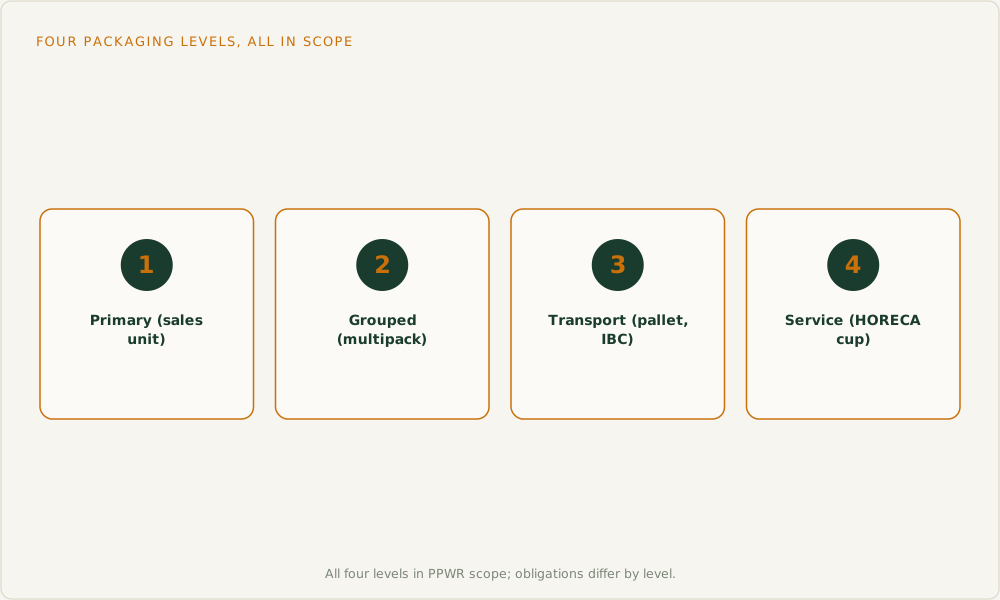
Annex I distinguishes three primary hierarchy levels (primary, grouped, transport) plus service packaging as a fourth category formalised in PPWR. All four are in scope; obligations differ by level.
Four Packaging Hierarchy Levels: All In Scope
Primary (Consumer/Sales) Packaging
The unit that reaches the consumer or end user. PET beverage bottles, kraft e-commerce mailers, branded retail bags, single-serve food trays. Primary packaging carries the heaviest obligation load: Annex II recyclability grading, Article 7 PCR thresholds, Article 5 PFAS limits for food-contact, harmonised labelling from 2028, digital product passport from 2029, and (notably) Article 24 packaging minimisation rules that bite hardest at this hierarchy level.
Grouped (Secondary) Packaging
Multipacks, shelf-ready trays, display cartons that bundle primary units for retail merchandising. Grouped packaging is in scope and graded under Annex II; it typically carries lighter sustainability constraints than primary packaging because the surface area is smaller relative to the product volume protected.
Transport (Tertiary) Packaging
Pallets, stretch wrap, corrugated cases, IBC totes, and other B2B logistics packaging that moves grouped or primary units between supply-chain nodes. Transport packaging is in scope and subject to Article 11 DoC obligations. Reusable transport packaging benefits from Article 9 reuse targets; single-use transport packaging faces stricter minimisation rules.
Service Packaging
Packaging filled at the point of sale: HORECA cups and food containers, market-vendor bags, deli wraps, coffee shop cups, single-serve condiment sachets. Service packaging was formalised as a distinct category in PPWR and is subject to specific HORECA restrictions from 12 February 2027.
What's Out of Scope: Four Narrow Exemptions
The exemption list is short and explicit. Most "exempt" claims at the boundary fail under audit; the Commission Guidance of 30 March 2026 confirmed strict reading.
Medicinal product packaging. Pharmaceutical packaging is covered by the separate EU pharmaceutical regulatory framework rather than PPWR. The exemption applies narrowly to the packaging that is regulated under the pharma directive (Directive 2001/83/EC and successors); ancillary outer cartons that do not perform a regulatory packaging function for the medicinal product itself may fall back into PPWR scope.
Veterinary medicinal products. Similar separate regime; the exemption mirrors the human pharma carve-out and applies on similar terms.
Long-term archival packaging. Museum and library long-term preservation packaging is out of commercial-placement scope because it is not "placed on the EU market" in the regulation's sense. The exemption is narrow: archival storage by a non-commercial institution is excluded; commercial archival services providing preservation packaging as a product are not.
Packaging integral to a non-packaging product. The rigid case housing of a power tool, the hardshell of a musical instrument that is sold as part of the instrument, the integrated carrying case of certain hand tools. The boundary call is whether the case is "packaging" (protecting and presenting the goods) or "product housing" (integral to and inseparable from the product). The distinction is often disputed; treat as in scope by default unless legal review confirms exemption.
A fifth implicit exemption: non-EU placement only. Packaging that never crosses an EU customs border is outside PPWR. Other regimes (CBAM for carbon-intensive imports, national regulations in the origin or destination country) may apply, but PPWR does not.
Reusable vs Single-Use Packaging
Both reusable and single-use packaging are in PPWR scope, with different obligations attached to each.
Single-use packaging is designed, conceived, and placed on the market for one use cycle. Annex VIII DoC retention is 5 years from last EU placement under Article 11(4). Article 24 minimisation rules apply most aggressively to single-use formats. Single-use plastic restrictions intersect (in scope of the parallel Single-Use Plastics Directive 2019/904).
Reusable packaging is designed, conceived, and placed on the market to accomplish multiple trips or rotations. DoC retention is 10 years from last EU placement. Reuse-cycle reporting begins 12 February 2027 for HORECA cups and food containers (deadline timeline walks the schedule). Article 9 reuse targets bind from 1 January 2030 for several format categories, including beverage transport, B2B grouped packaging, and several retail formats.
The reusable designation is not a paperwork label; the packaging must be operationally reusable in practice. A "reusable" cup that is in fact discarded after one use does not gain the reusable designation. The Commission Guidance of 30 March 2026 confirmed that the designation requires evidence of an operational reuse system, not just a marking on the pack.
Service Packaging Edge Cases
Service packaging (HORECA, vendor, deli) is in scope of PPWR regardless of where the pack is filled. The 12 February 2027 HORECA milestone in the deadline timeline imposes single-use restrictions on dine-in cups and food containers, with reuse-cycle reporting beginning the same date.
The operational tension is producer-level traceability: a coffee shop chain operating across 200 outlets cannot trace each individual cup back to a specific manufacturer or batch at audit. The Commission Guidance of 30 March 2026 rejected a blanket exemption argued by operators on logistics grounds and confirmed that PPWR obligations attach to the producer (cup supplier) and the brand owner (coffee chain placing the cup on the market with their branding). Operators bear the operational logistics; PPWR holds them to the same compliance standard as packaged consumer goods.
Manufacturer vs Producer: Two Terms, Two Regimes
The Commission Guidance of 30 March 2026 clarified two terms that producers had been using interchangeably.
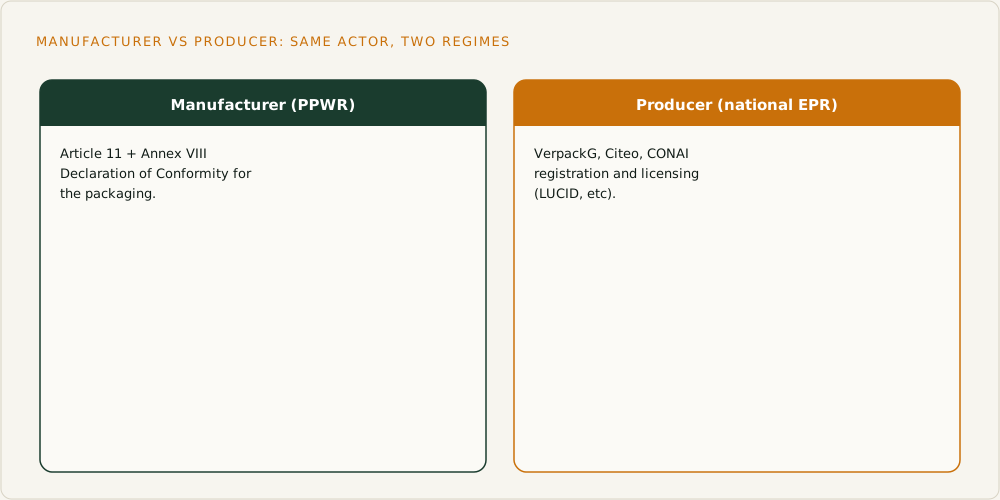
Manufacturer is the party that designs and produces the packaging (or, under Article 21, the party that places packaging on the EU market under their own brand). PPWR uses "manufacturer" as the regulatory issuer of the Annex VIII DoC. The manufacturer is the regulator's primary contact for substantive Article 5 to 12 obligations.
Producer is the broader concept used in national EPR (Extended Producer Responsibility) schemes: VerpackG in Germany, Citeo in France, CONAI in Italy, Ecoembes in Spain, Afvalfonds in the Netherlands. A "producer" in this sense is the party with operational and financial responsibility for the end-of-life management of the packaging, typically the party placing it on the national market.
The two terms often refer to the same actor but route to different regimes. A German retailer's private-label SKU triggers both: PPWR manufacturer under Article 21 (issues the DoC; substantive sustainability obligations) and VerpackG producer (LUCID registration with ZSVR; eco-modulation fees). The actor satisfies both regimes through separate documentation and registration workflows. The Germany VerpackG and PPWR guide walks the dual-compliance pathway.
For sourcing teams and legal review, the practical rule is: the two regimes apply in parallel, neither replaces the other, and documentation must satisfy both on their own terms.
Frequently Asked Questions
Q1: Is industrial / B2B packaging covered by PPWR? Yes. Transport packaging (pallets, IBC totes, corrugated cases, stretch wrap) and grouped packaging (multipacks, shelf-ready trays) are in PPWR scope under Annex I. Obligations differ from primary consumer packaging (Article 24 minimisation rules bite less aggressively), but DoCs are required and recyclability grading applies.
Q2: Does PPWR apply to medical device packaging? Medicinal product packaging covered by the EU pharmaceutical regulatory framework is exempt. Medical device packaging that does not fall under the pharma directive is generally in PPWR scope. The boundary call depends on whether the packaging is regulated as part of the medicinal product under a separate regime; legal review on a per-product basis is the right move at this edge.
Q3: What about packaging for products that never enter the EU? PPWR does not apply to packaging that never crosses an EU customs border. CBAM and national regulations in origin or destination countries may apply, but PPWR is triggered by EU placement. This is not a compliance strategy: most cross-border supply chains touching EU partners or EU consumers do cross the border at some point.
Q4: Are biodegradable and compostable packaging items in scope? Yes. PPWR is material-neutral; biodegradable polymers and compostable substrates are in scope when they perform a packaging function. Compostable claims for specific format categories (tea bags, coffee pods, fresh-fruit labels, fruit/veg bags) become subject to EN 13432 certification requirements from 1 January 2028 per the deadline timeline.
Q5: Is the case housing of a power tool considered "packaging"? The boundary call is whether the case is "packaging" (protecting and presenting the goods for sale) or "product housing" (integral to and inseparable from the product itself). A hardshell case sold as part of the tool, used during operation, and not discarded after sale is product housing. A protective carton or foam insert discarded after unpacking is packaging. Disputed cases default to PPWR scope under audit; document the case purpose if claiming exemption.
Q6: Does PPWR apply to non-EU exporters? Indirectly. Non-EU exporters do not directly issue Annex VIII DoCs unless they have an EU establishment, but their packaging is in PPWR scope from the moment the EU importer places it on the EU market. Under Article 21, the EU brand owner becomes the manufacturer of record. Non-EU exporters become the EU partner's technical data supplier.
Q7: What is the difference between "manufacturer" and "producer" under PPWR? "Manufacturer" is the PPWR regulatory term for the issuer of the Annex VIII DoC (the party that designs and produces, or the party that triggers Article 21 by branding). "Producer" is the broader concept used by national EPR schemes (VerpackG, Citeo, CONAI, Ecoembes) for the party with operational and financial end-of-life responsibility. The same actor often plays both roles; the two regimes apply in parallel.
Conclusion
PPWR scope is broad and exemptions are narrow. The Annex I packaging definition catches every material and format that performs a packaging function. The four-level hierarchy (primary, grouped, transport, service) is uniformly in scope, with obligations differing by level. Four explicit exemption categories cover medicinal product packaging, veterinary medicinal products, long-term archival packaging, and packaging integral to a non-packaging product. The non-EU exemption is implicit (packaging that never crosses an EU customs border) and not a compliance strategy.
The most common scope confusion is the manufacturer-versus-producer terminology: same actor, two regimes (PPWR + national EPR), neither replaces the other. The Commission Guidance of 30 March 2026 confirmed strict reading on the boundary cases this guide walks.
For role-specific routing, go to the stakeholder roles guide. For Article 21 branded-import scenarios, go to the Article 21 importer-as-manufacturer guide. For the operational sprint, go to the 90-day readiness plan. For the full regulation reference, go to the PPWR compliance pillar.
Carbonorm applies the Annex I scope test automatically per SKU and routes each in-scope type through the Annex VIII DoC engine. Start Audit; 50 SKUs free, no card required.
---
Read next:
- PPWR Compliance Pillar →
- What Is PPWR? Plain-English Overview →
- Who Does PPWR Apply To? Stakeholder Roles →
- PPWR Article 21 Importer-as-Manufacturer →
- PPWR Deadlines Timeline 2026 to 2030 →
- Germany VerpackG Overlay →
---