What Is PPWR? The EU Packaging Regulation Explained in 5 Minutes
What Is PPWR? The EU Packaging Regulation Explained in 5 Minutes
If you make, import, or sell packaged products in the European Union, PPWR is the regulation you will be audited against from 12 August 2026. This guide explains what PPWR is, what it replaces, who it applies to, and the two deadlines that matter most. Five minutes to the working answer; the PPWR compliance pillar is the full reference when you need depth.
In this guide:
- PPWR defined in one paragraph
- What "PPWR" stands for, plus quick facts
- What PPWR replaces (and why the shift matters)
- Who PPWR applies to
- What changes for packaging producers
- The two hard dates: 12 August 2026 and 1 January 2030
- Where to go next
PPWR in One Paragraph
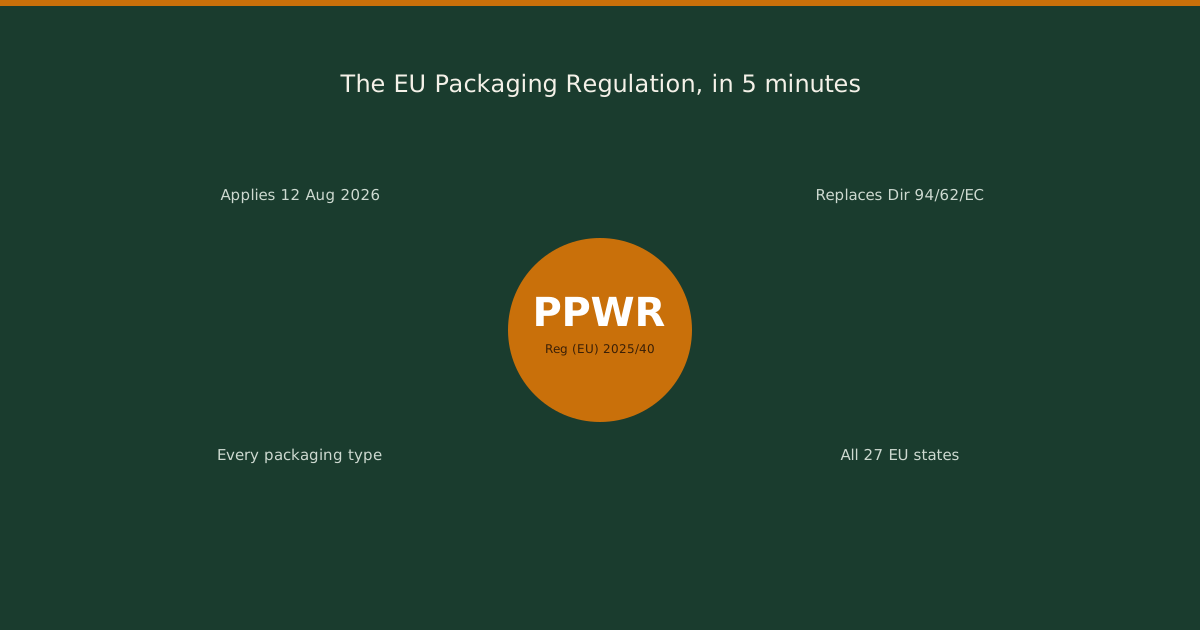
PPWR is the Packaging and Packaging Waste Regulation, [Regulation (EU) 2025/40](https://eur-lex.europa.eu/eli/reg/2025/40/oj), the directly-applicable EU law that sets sustainability, recyclability, recycled-content, labelling, and reuse requirements for every type of packaging placed on the EU market from 12 August 2026. It replaces the prior Packaging and Packaging Waste Directive 94/62/EC and applies uniformly across all 27 EU Member States. Every packaging type must carry a signed Declaration of Conformity following the Annex VIII model, graded against Annex II recyclability criteria.
That single paragraph is the 40-second answer. The rest of this guide unpacks the parts that matter for operational planning.
What "PPWR" Stands For, Plus Quick Facts
PPWR is the working acronym for the Packaging and Packaging Waste Regulation. The German shorthand for the same regulation is PPWR in EU contexts and Verpackungsverordnung 2026 (or simply "PPWR") in DACH-region writing. The Turkish translation in trade press is AB Ambalaj Yönetmeliği.
| Quick fact | Value |
|---|---|
| Full name | Packaging and Packaging Waste Regulation |
| Legal reference | Regulation (EU) 2025/40 |
| Adopted | 19 December 2024 |
| Entered into force | 11 February 2025 |
| Applies from | **12 August 2026** |
| Geographic scope | All 27 EU Member States |
| Replaces | Directive 94/62/EC (the previous Packaging Directive) |
| Type of legal instrument | Regulation (directly applicable, no national transposition) |
| Latest authoritative guidance | [Commission Guidance and FAQ, 30 March 2026](https://ec.europa.eu/commission/presscorner/detail/en/ip_26_664) |
The 18-month transition window between entry into force (February 2025) and application (August 2026) was deliberate. It is short for any portfolio above 200 SKUs, which is why most large producers began their compliance work in 2025.
What PPWR Replaces (and Why the Shift Matters)
PPWR replaces the [Packaging and Packaging Waste Directive 94/62/EC](https://eur-lex.europa.eu/legal-content/EN/TXT/?uri=CELEX:01994L0062-20180704), in force since 1994. The two are not the same kind of law; the change in legal instrument is the headline.
- A Directive sets goals that each Member State must transpose into national law. Implementation varies across the EU.
- A Regulation applies directly and uniformly across all 27 Member States, with no national transposition required.
The shift from Directive to Regulation eliminates a decade of inconsistency in how EU Member States interpreted and enforced packaging law. National schemes that predate PPWR (Germany's VerpackG, France's Loi AGEC, Italy's CONAI, Spain's Ecoembes) remain in force for the obligations they uniquely cover (national registration, eco-modulation fees, take-back logistics), but the substantive sustainability requirements now come from PPWR and are uniform.
For producers, the practical implication is simple: the Declaration of Conformity is one document that satisfies every Member State, while the national registration obligations continue separately.
Who PPWR Applies To
PPWR covers every actor in the packaging value chain: manufacturers, importers, distributors, fulfilment service providers, and brand owners. There is no SME carve-out, no minimum volume threshold, and no exemption by country of origin. If packaging is placed on the EU market, PPWR applies.
The four primary roles:
- Manufacturer. Designs and produces the packaging. Issues the Declaration of Conformity.
- Importer. Places third-country packaging on the EU market. Verifies the manufacturer's DoC and retains a copy.
- Distributor. Places packaging downstream within the EU. Refuses to handle packaging unsupported by a valid DoC.
- Fulfilment service provider. Stores, packs, or ships packaging on behalf of others; carries cross-border responsibilities, especially for e-commerce.
A critical wrinkle: under PPWR Article 21, an importer placing packaging on the EU market under their own brand becomes the manufacturer for PPWR purposes and issues the DoC themselves. This rule affects most private-label, white-label, and OEM-branded arrangements. The stakeholder roles guide walks each role with a decision tree.
What Changes for Packaging Producers
From 12 August 2026, every packaging type placed on the EU market must satisfy six structural obligations. Each connects to a specific Article of the regulation.
- Declaration of Conformity. Every packaging type carries a signed DoC following the Annex VIII model. (Article 11, Annex VIII template)
- Recyclability grade. Every type graded A through E using the Annex II worst-of methodology. Grade D and E packaging restricted from 1 January 2030. (Article 6, Annex II worst-of guide)
- Recycled content thresholds. Binding post-consumer recycled (PCR) content minimums by polymer family, phasing in from 2030 and 2040. Contact-sensitive PET reaches 30% PCR by 2030. (Article 7)
- PFAS restrictions. Per- and polyfluoroalkyl substances limited in food-contact packaging from 12 August 2026. (Article 5)
- Harmonised labelling. Standard material and sorting pictograms across the EU from August 2028.
- Audit-ready retention. DoCs and technical files retained for 5 years (single-use) or 10 years (reusable) from last EU placement.
Failure to meet any of these triggers escalation under Article 67 penalties, which Member States set individually (Germany tops out near €200,000 per breach; Eastern EU sits lower).
The Two Hard Dates: 12 August 2026 and 1 January 2030
PPWR's enforcement is phased across six milestones from 2026 to 2030. Two of those dates carry most of the operational weight.
12 August 2026: General application. The regulation activates. From this date, no packaging type may be placed on the EU market without a valid Annex VIII DoC. Article 5 (PFAS) and Article 11 (DoC) become enforceable. Member State authorities can request DoCs and must receive them within 10 working days under Article 11(5).
1 January 2030: Full enforcement cliff. Grade D and E packaging types may no longer be placed on the EU market (subject to limited exceptions). The 30% PCR threshold for contact-sensitive PET becomes binding. Reuse targets bind for several formats. Article 24 packaging minimisation rules apply.
The intervening dates (12 February 2027 HORECA; 1 January 2028 recyclability sharpening; 12 August 2028 harmonised labelling; 12 February 2029 digital product passport / QR codes) are the operational schedule between the two cliffs. The full deadline cascade walks all six milestones with stakeholder actions.
Where to Go Next
This guide is the orientation. The next-step destinations depend on your role and timeline.
- You have not started compliance work yet. Go to the 90-day readiness plan for the sprint structure that lands a 400-SKU portfolio audit-ready by 12 August 2026.
- You need to draft your first DoC. Go to the Annex VIII template guide for the 12-field walkthrough plus three worked examples and a downloadable template.
- You import packaging branded under your name. Go to the Article 21 importer-as-manufacturer guide for the trigger conditions and the four worked scenarios.
- You operate in the German market. Go to the Germany VerpackG and PPWR guide for the LUCID / ZSVR dual-compliance pathway.
- You want the full reference. Go to the PPWR compliance pillar for the comprehensive guide.
Frequently Asked Questions
Q1: What does PPWR stand for? PPWR stands for Packaging and Packaging Waste Regulation. The full legal reference is Regulation (EU) 2025/40. In German, the term is used directly (PPWR or Verpackungsverordnung 2026); in Turkish, the trade press uses AB Ambalaj Yönetmeliği.
Q2: When does PPWR apply? PPWR applies from 12 August 2026 across all 27 EU Member States. Additional milestones phase in through 1 January 2030, including grade D and E restrictions, binding PCR thresholds, and harmonised labelling.
Q3: Does PPWR apply to my company if I am not based in the EU? Yes, if your packaging is placed on the EU market. Under Article 21, the EU-side importer or brand owner becomes the manufacturer for PPWR purposes if your name is on the packaging. The regulatory obligation routes to the EU-side party; you become the technical data supplier.
Q4: Is there an exemption for small companies? No. PPWR carries no SME carve-out, no minimum volume threshold, and no exemption by country of origin. The Commission Guidance of 30 March 2026 confirmed the rule applies to every producer regardless of size.
Q5: What is the difference between PPWR and the old Packaging Directive? The Packaging Directive 94/62/EC required each Member State to transpose into national law, which produced 27 different national versions. PPWR is a directly-applicable Regulation: uniform across the EU, binding numerical thresholds (PCR content, grade restrictions), new requirements (DoC under Annex VIII, harmonised labelling, digital product passport), and Article 67 penalties set by each Member State within a common framework.
Q6: What happens if I do nothing by 12 August 2026? Packaging types lacking a valid Annex VIII DoC cannot be placed on the EU market from that date. Member State authorities can request DoCs immediately, issue corrective-action notices, escalate to fines under Article 67, and require market withdrawal of non-compliant types. Existing inventory already placed before the deadline can continue moving through the channel.
Conclusion
PPWR is the EU's new packaging law, replacing a 30-year-old Directive with a directly-applicable Regulation that applies uniformly from 12 August 2026. The substantive obligations (Annex VIII DoC, Annex II recyclability grade, Article 7 PCR thresholds, Article 5 PFAS limits) hit every packaging type placed on the EU market. The 2030 cliff makes early redesign work commercially efficient: grade D and E types redesigned now save the remediation cost in 2030.
The five-minute version is enough to orient. The operational sprint is in the 90-day readiness plan, the full reference is in the pillar guide, and the practical artefact is the Annex VIII DoC template. Carbonorm runs the full workflow end-to-end. Start Audit; 50 SKUs free, no card required.
---
Read next:
- PPWR Compliance Pillar →
- PPWR Deadlines Timeline 2026 to 2030 →
- Who Does PPWR Apply To? Stakeholder Roles →
- PPWR Article 11 Declaration of Conformity →
- PPWR Annex VIII DoC Template →
- 90-Day PPWR Readiness Plan →
- PPWR Glossary →
---