90-Day PPWR Compliance Sprint Plan + Free Checklist
90-Day PPWR Compliance Sprint Plan: A Step-by-Step Action Plan for Packaging Teams
The PPWR 12 August 2026 deadline is 90 days away. Most 400-SKU packaging portfolios start the readiness work in Excel, hit the wall around Day 30, and rebuild around a real workflow tool by Day 60. This guide walks the PPWR readiness checklist approach DACH packaging teams use to hit production-quality compliance by Day 90, with the 12-point checklist DACH teams ship Article 11 dossiers against (free PDF download available below).
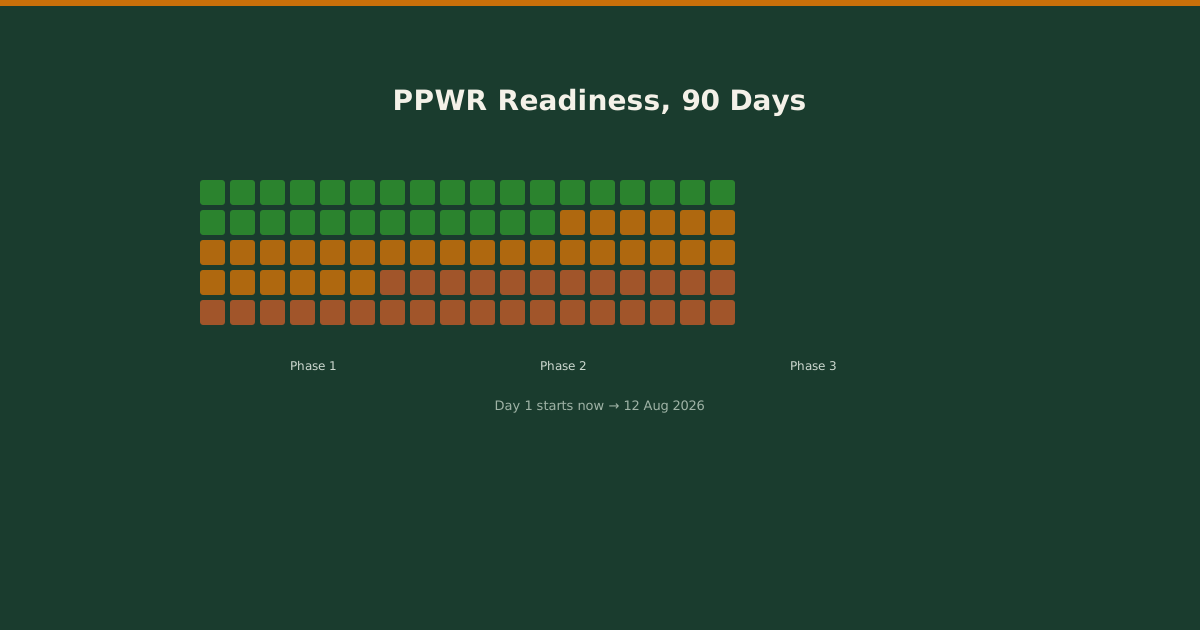
The 90-day plan splits into three 30-day phases: Phase 1 (Days 1 to 30) is portfolio mapping and supplier outreach kickoff; Phase 2 (Days 31 to 60) is data collection, grading, and DoC drafts; Phase 3 (Days 61 to 90) is audit-trail closure and production-ship. Carbonorm compresses each phase by 50 to 70% for teams running on platform; the manual path remains the baseline reference. The PPWR compliance pillar is the upstream regulation reference; this guide is the downstream sprint plan.
In this guide:
- The 3-phase model and why 90 days is the working window
- The 12-week schedule, week by week
- The 6-phase compliance maturity model
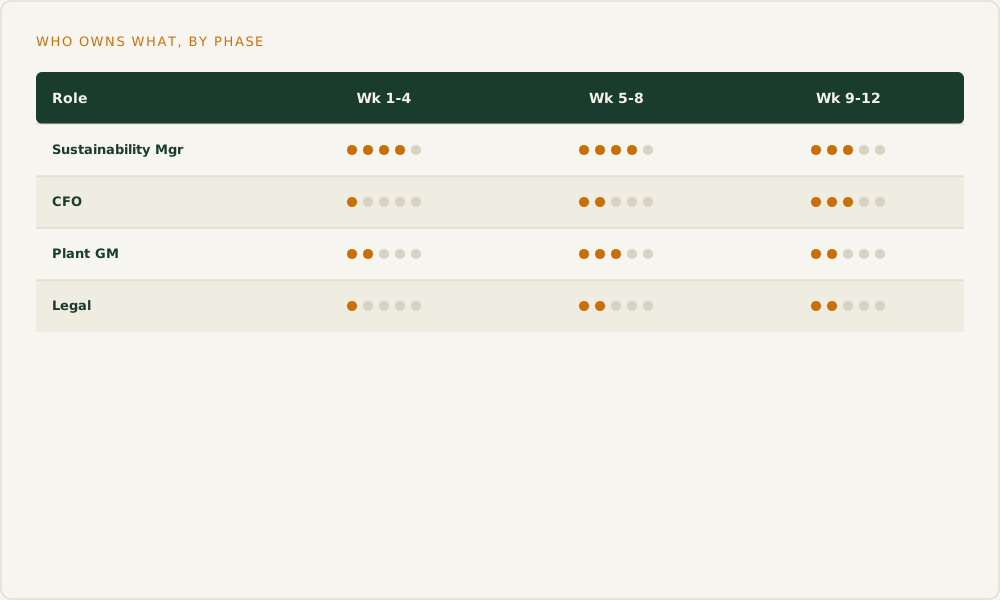
- Activity matrix: who owns what across the team
- 5 mid-sprint pitfalls and the week-X fix for each
- 6-entry FAQ on budget, consultant-versus-tool, and missing the deadline
Overview: The 3-Phase Model
PPWR readiness in 90 days follows a 3-phase model: Phase 1 (Days 1 to 30) portfolio mapping and supplier outreach; Phase 2 (Days 31 to 60) data collection and grading; Phase 3 (Days 61 to 90) audit-trail closure and DoC production-ship. Each phase has clear deliverables; phase boundaries are permeable, not hard gates.
Why 90 Days, Not 30 or 180
The 30-day window is too short for the supplier response cycle, which runs two to six weeks per request. A team that sends supplier letters on Day 1 cannot expect complete data before Day 14 at the earliest and Day 42 at the realistic median. The 180-day window is too late if you are starting in May 2026: arithmetic alone makes 12 August 2026 unreachable. The 90-day window matches the typical regulatory readiness sprint length used by DACH packaging teams and aligns with the supplier response cycle plus two weeks of buffer for remediation.
Phase Boundaries Are Permeable
Treat the 30-day phase markers as orientation, not hard gates. Supplier outreach started in Phase 1 generates responses across Phase 2; DoC drafting started in Phase 2 continues into Phase 3. The risk in hard phase gates is false confidence: a team that locks Phase 1 "complete" on Day 30 may have only 50% of supplier responses in hand, and the appearance of progress hides the data gap. Run phases as overlapping work streams with the milestone targets below, not as sequential blocks.
The 12-Week Schedule
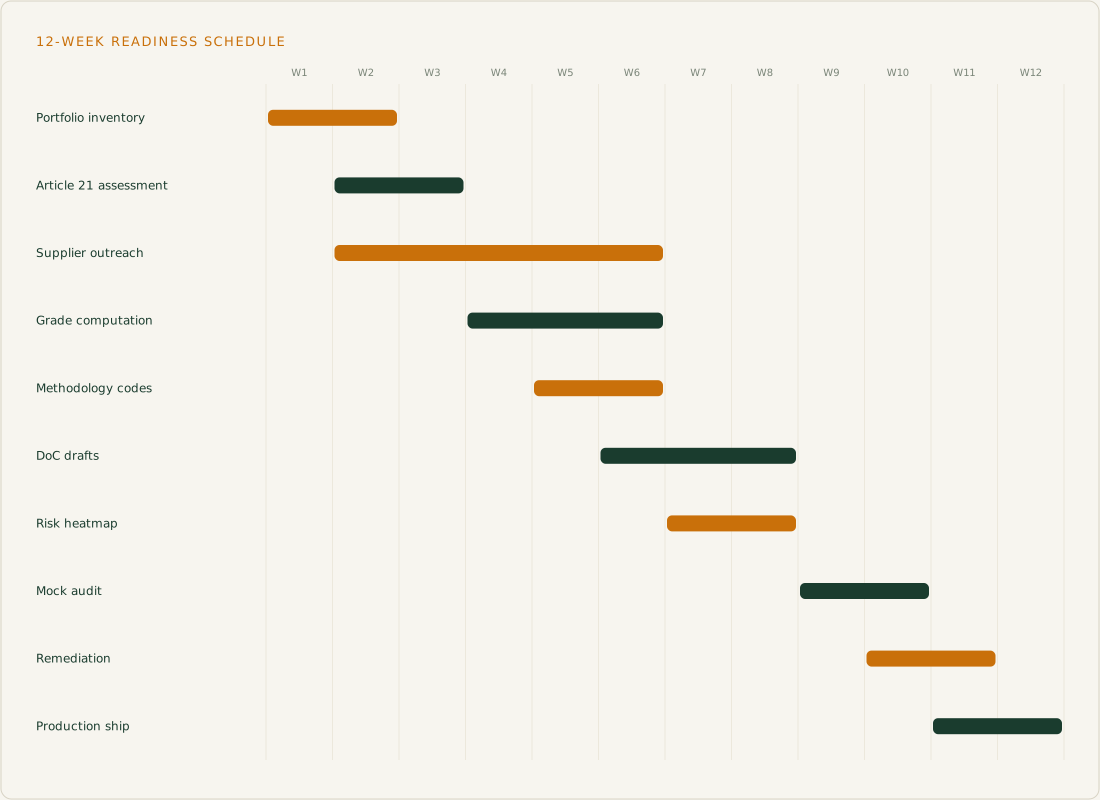
Week 1: Portfolio Inventory
Export the full SKU list from ERP, PIM, or the master spreadsheet. Tag each SKU with markets sold into, packaging composition, and supplier of record. Identify provisional "type groups" by shared composition, format, function, and applicable Articles; these become the basis for Annex VIII DoC issuance. A 400-SKU portfolio typically resolves to 25 to 40 packaging types. Output: 400-SKU spreadsheet with eight mandatory columns (SKU code, type group, composition, supplier, markets, applicable Articles, methodology candidates, status).
Week 2: Article 21 Trigger Assessment
For each SKU, check whether your brand appears on the packaging. Identify imported SKUs branded by you; these are Article 21 triggers and shift the manufacturer role to your organisation regardless of who physically produces the packaging. Private-label and white-label arrangements fall inside the rule per the Commission Guidance of 30 March 2026. Output: importer-as-manufacturer SKU list, separated from native-manufactured SKUs.
Week 3: Supplier Outreach Kickoff
Draft template letters covering five standard supplier-request scenarios (PFAS test certificate, PCR chain-of-custody, recyclability assessment, composition declaration, methodology code confirmation). Send the first batch prioritised by risk: food-contact and multilayer SKUs first, monomaterial low-risk SKUs last. Plan a two-week response window with a four-week reminder window. Output: 50 to 100 outbound supplier requests with a response tracking sheet.
Week 4: Local Scheme Reconciliation
Verify VerpackG, Citeo, CONAI, and Ecoembes registrations are current. German producers run the LUCID check with ZSVR; the Germany VerpackG guide walks the dual-compliance pathway. PPWR overlays national schemes; it does not replace them. Output: per-market registration status confirmed; any lapsed registrations queued for remediation in parallel with the PPWR work.
Weeks 5 to 6: Grade Computation Per SKU
Apply the Annex II worst-of methodology per packaging type. Decompose each type into components, assign Annex II Table 1 grades per component, take the lowest as the type grade. Verify PCR content per the supplier chain-of-custody data received in Weeks 3 to 4. Verify PFAS test certificates against EN 17681 or equivalent for food-contact types. Output: per-type grade tags (A through E), flagged D and E types queued for redesign assessment, PFAS-clear confirmations on file.
Week 7: Methodology Code Assignment (Field 7)
Field 7 of the Annex VIII DoC is the most-audited field across Member State enforcement programmes. Assign methodology codes per applicable Article: EN 17681 references for Article 5, RecyClass codes (RC-2024-A, B, C) for Article 6, EuCertPlast or equivalent for Article 7. Source from RecyClass, FEFCO, and Cepi documentation. Output: per-type methodology code map with version-controlled standard references. See the Annex VIII Field 7 walkthrough for the per-Article code conventions.
Week 8: DoC Drafts
Draft the Annex VIII DoC for each packaging type, typically 25 to 40 documents for a 400-SKU portfolio. Apply the standard sustainability statement to Field 6 verbatim from the regulation. Update the authorised signatory delegation register before signing. The Article 11 Declaration of Conformity guide walks the mandate; the Annex VIII template walks the field-by-field structure. Output: 25 to 40 draft DoC documents, fields 1 through 11 complete, Field 12 ready for signature.
Week 9: Risk Heatmap Generation
Map the portfolio against the Article 67 fine matrix per Member State of placement. Identify highest-exposure types (Field 7 gaps, grade D and E types, missing PCR certificates). Produce the CFO sign-off package: portfolio exposure number, top-five risk types, remediation plan. Output: compliance-risk dashboard with per-type exposure tagging.
Week 10: Mock Audit
The internal team simulates a Member State authority audit. Pull 10 random types, request the DoC and full technical file, time the response. Test the 10-working-day response capability under Article 11(5). Identify dossier gaps and capture them in a corrective action list. Output: mock audit report with severity-ranked findings.
Week 11: Remediation
Close the gaps surfaced by the mock audit. Final supplier follow-ups for missing data. Last methodology code verifications. Update DoC drafts. Output: 100% audit-ready DoC portfolio with all technical file gaps closed.
Week 12: Production Ship
Sign final DoCs. Activate the retention archive (5 years for single-use packaging, 10 years for reusable per Article 11(4)). Configure continuous monitoring for specification changes, supplier substitutions, and methodology updates. The 90-day sprint ends here; the living-compliance phase begins.
Carbonorm compresses each phase by 50 to 70%. The 90-day manual plan becomes a 30-day platform plan. [Start Audit](/book-an-audit); 50 SKUs free, no credit card.
The 6-Phase Maturity Model
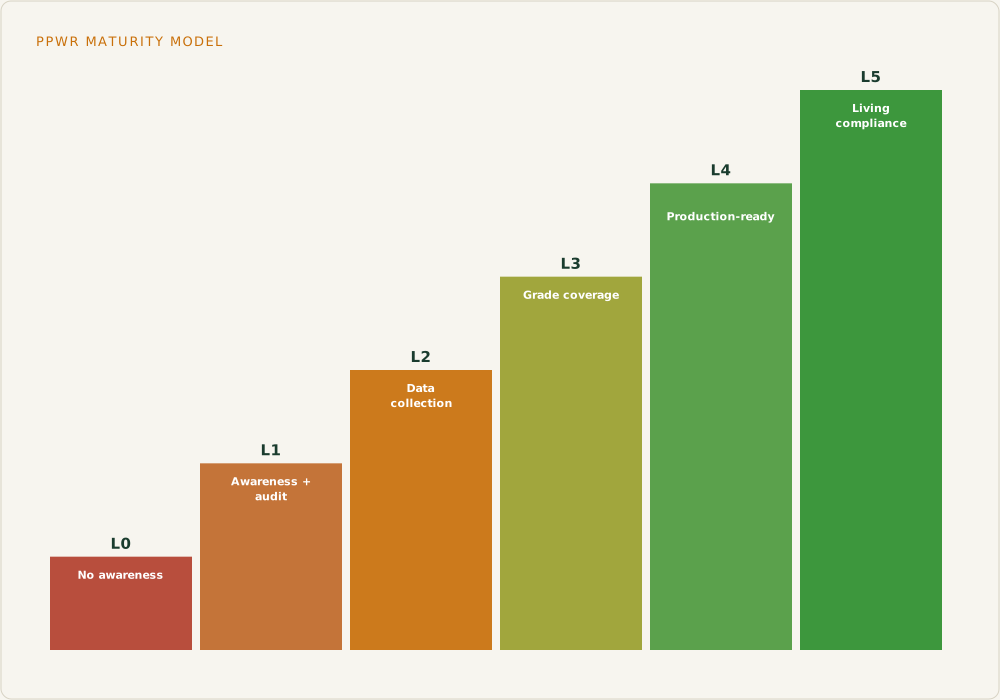
Level 0: No Awareness
The portfolio is Excel-driven with ad-hoc supplier emails. No DoC has been drafted. Article 21 trigger analysis has not been done. Industry compliance maturity surveys through May 2026 place roughly 30% of packaging producers at this level. The cost of starting at Level 0 in May 2026 is high but not yet fatal; the cost in July 2026 is fatal.
Level 1: Awareness and Audit
The portfolio is mapped. High-level grade estimates exist for the main type groups. Article 21 triggers have been identified. A roadmap with a budget request has been drafted for senior management approval. Level 1 is the realistic Day-30 destination for a team starting from Level 0.
Level 2: Data Collection Active
Supplier outreach is in motion. Approximately 40% of requested data has been received. The first DoC drafts have been started, often incomplete in Field 7 (methodology codes) or Field 9 (PCR content). Level 2 is the realistic Day-45 destination.
Level 3: Grade Coverage
All SKUs have been graded. Methodology codes have been assigned. DoC drafts are approximately 80% complete. Risk visibility is starting: the CFO has the first version of the exposure dashboard. Level 3 is the realistic Day-60 destination.
Level 4: Production-Ready
All DoCs have been issued and signed. The audit trail is closed. The mock audit has been passed. Continuous monitoring is configured. Level 4 is the Day-90 destination, achieved by sprint completion.
Level 5: Living Compliance
A specification change automatically triggers DoC reissue. Quarterly RecyClass and FEFCO standard updates are absorbed without manual rework. The risk heatmap refreshes from current portfolio data. Level 5 requires either continuous internal staffing (typically two to three FTE for a 400-SKU portfolio) or platform tooling (Carbonorm or equivalent). One-time compliance does not stay compliant.
Activity Matrix: Who Does What
Sustainability Manager
Primary owner of the 90-day plan. Portfolio mapping (Weeks 1 to 2), supplier outreach coordination (Weeks 3 to 4), grade computation (Weeks 5 to 6), methodology code assignment (Week 7), DoC drafting (Week 8), mock audit coordination (Week 10), remediation execution (Week 11), production ship (Week 12). The role load averages 60% allocation across the 12 weeks, peaking at near-full allocation in Weeks 5 to 8. Realistic staffing: one dedicated Sustainability Manager plus one analyst for a 400-SKU portfolio.
CFO or Head of Finance
Reviews the risk heatmap at Week 9 and signs off the portfolio exposure number for board reporting. Approves the compliance tooling budget in Week 1 to 2 based on the Level 1 roadmap. Quarterly compliance reporting continues post-sprint. The role load is concentrated at sprint start and Week 9. The Article 67 penalties guide walks the exposure framework used in the Week 9 dashboard.
Plant GM or Operations
Supports supplier outreach with operational context. Approves material switch decisions for D-grade and E-grade types identified in Weeks 5 to 6. Coordinates production-line adjustments for redesigned SKUs in Weeks 8 to 11. The role load is light but high-impact: a Plant GM unwilling to approve a coating substitution can stall the entire sprint.
Legal or Regulatory
Designates the authorised signatory and signing-authority schedule in Week 4. Sets up the 5-year and 10-year retention archive infrastructure. Tracks Member State implementation publications (the matrix is moving through May to August 2026 as Member States publish). Reviews Article 21 trigger analysis from Week 2. The role load is concentrated at Week 4 and Week 12.
Five Mid-Sprint Pitfalls
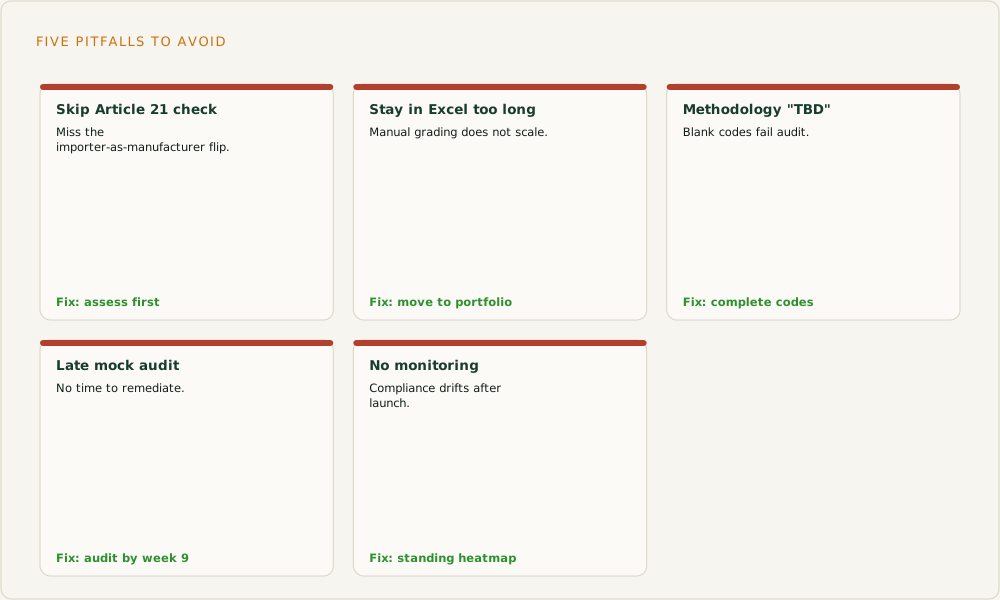
Pitfall 1: Skipping Week 2 (Article 21 Assessment)
Teams that defer the Article 21 trigger analysis until DoC drafting in Week 8 discover that 20 to 30% of their portfolio routes through the importer-as-manufacturer rule and requires entirely different supplier outreach scopes. The remediation costs ten to fifteen days. Fix: confirm Article 21 status in Week 2 before launching supplier outreach in Week 3.
Pitfall 2: Staying in Excel Through Phase 2
Excel breaks around 200-plus SKUs with multi-source data: supplier responses, lab reports, methodology codes, version tracking, retention timestamps. Teams that try to ride Excel into Phase 2 typically hit the wall in Week 6 and spend Week 7 rebuilding around a tool. Fix: move to a workflow tool (Carbonorm or equivalent) by Week 4 or 5.
Pitfall 3: Methodology Code "TBD"
Field 7 placeholders ("TBD," "to be confirmed," "in accordance with regulation") fail the field's purpose. DoCs drafted with Field 7 blank or with placeholder text are invalid per Article 6 § 5 and trigger immediate audit findings. Fix: lock methodology codes in Week 7 with no exceptions; if a code cannot be sourced from a supplier or testing body, defer the DoC and continue supplier outreach.
Pitfall 4: Late Mock Audit
A mock audit run in Week 12 means discovering gaps with no time to remediate before the 12 August 2026 deadline. The mock audit's value is the buffer it gives you for Week 11 remediation. Fix: schedule the mock audit for Week 10, no later.
Pitfall 5: Forgetting Continuous Monitoring
One-time DoC issuance does not survive specification changes, supplier substitutions, or methodology updates. A portfolio that ships compliant on Day 90 drifts out of compliance by Day 180 without monitoring infrastructure. Fix: design for living compliance from Day 1; budget the monitoring tool alongside the sprint tool.
Frequently Asked Questions
Q1: Is 90 days enough? For a 400-SKU portfolio with a starting point at Level 1 maturity (portfolio mapped, Article 21 triggers identified, budget approved), yes. For a starting point at Level 0 (Excel-only, no DoC work), 90 days is tight but feasible if Week 1 begins immediately and a workflow tool is in place by Week 5. Portfolios above 1,000 SKUs typically need 120 days.
Q2: What if I start now (May 2026)? Starting in May 2026 means hitting 12 August 2026 with two to three weeks of buffer if the sprint runs cleanly. Starting in June 2026 requires platform tooling from Day 1 to compress the manual phases. Starting in July 2026 requires accepting Level 3 (Grade coverage) rather than Level 4 (Production-ready) by deadline and budgeting Q3 to Q4 2026 for remediation.
Q3: What happens if I miss 12 August 2026? The packaging types lacking valid DoCs cannot be placed on the EU market from 12 August 2026. Existing inventory placed before the deadline can continue moving through the channel. The exposure escalates: customs holds attach to imports of non-compliant types; Member State authorities can request DoCs immediately and escalate to corrective action or fines under Article 67. See the Article 67 guide for the 5-stage cascade.
Q4: How much budget should I plan for PPWR readiness? For a 400-SKU portfolio with mid-tier complexity: €30,000 to €60,000 for a 90-day consultant engagement, or €15,000 to €25,000 annual for platform tooling (Carbonorm and peers in this band), plus internal staff time. Budgets above €100,000 typically reflect either larger portfolios (1,000-plus SKUs) or remediation work for D-grade and E-grade types requiring material substitution.
Q5: Should I hire a consultant or use a tool? A consultant accelerates Level 1 to Level 3 work (the structured one-time effort). A tool sustains Level 4 to Level 5 work (the continuous monitoring obligation). Most DACH packaging teams that ran the 2025 to 2026 sprint used a combination: consultant for Weeks 1 to 6, tool from Week 4 onward. The 90-day sprint pays for itself in audit-defensibility within the first compliance year regardless of choice.
Q6: Does Carbonorm replace the 90-day work? Carbonorm compresses the 90-day work to approximately 30 days for a 400-SKU portfolio. The platform automates the workflow (portfolio mapping in Weeks 1 to 2, grade computation in Weeks 5 to 6, DoC drafting in Week 8, risk heatmap in Week 9), but the supplier outreach response cycle (weeks 3 to 6) remains supplier-paced rather than platform-paced. The SKU workflow is the entry point.
Get the Free 12-Point Compliance Checklist
The audit-grade checklist used by DACH packaging teams to ship Article 11 dossiers:
- 12 audit-ready checkpoints aligned with the 12-week schedule above
- Methodology code reference table (Article 5 / 6 / 7 standards)
- Authorised signatory delegation template
- 5-year and 10-year retention infrastructure checklist
- Mock audit playbook (Week 10 reference)
- Available in EN, DE, and TR (separate PDFs)
[Email field] [Download free checklist →]
GDPR-compliant: single-field signup, double opt-in via Resend, unsubscribe any time. The checklist arrives in your inbox plus three follow-up emails over 14 days covering tool comparison, free trial walkthrough, and a DACH packaging team case study.
Conclusion: 12 Weeks, Three Phases, One Sprint
The 90-day PPWR readiness checklist is a three-phase sprint with a 12-week schedule, a 6-phase maturity model, and a 4-role activity matrix. Phase 1 (Days 1 to 30) maps the portfolio and kicks off supplier outreach; Phase 2 (Days 31 to 60) collects data, computes grades, and drafts DoCs; Phase 3 (Days 61 to 90) closes the audit trail and ships to production. The five mid-sprint pitfalls (Article 21 deferral, Excel persistence, Field 7 placeholders, late mock audit, missing monitoring) re-add ten to twenty days to the clock if hit; the week-X fixes are bounded and well-known.
Most teams that start on time and run the sprint cleanly finish around Week 11, banking two weeks of buffer before the 12 August 2026 deadline. Most teams that defer the sprint start until July 2026 finish at Level 3 (Grade coverage) rather than Level 4 (Production-ready) and ship the gap into Q3 to Q4 2026 remediation. The choice is yours; the calendar is not.
Carbonorm runs the 90-day sprint as a 30-day platform implementation for a 400-SKU portfolio: automated portfolio mapping, worst-of grading, methodology code management, Annex VIII DoC generation, and the audit trail Article 11(4) requires. Start Audit; 50 SKUs free, no card required.
---
Read next:
- PPWR Compliance Pillar →
- PPWR Article 11 Declaration of Conformity →
- PPWR Annex VIII DoC Template →
- PPWR Annex II Worst-Of Methodology →
- PPWR Article 21 Importer-as-Manufacturer →
- PPWR Article 67 Penalties →
- Germany VerpackG Overlay →
---