PPWR Article 21: When Importers Become Manufacturers
PPWR Article 21: When Importers Become Manufacturers (And Must Issue the DoC)
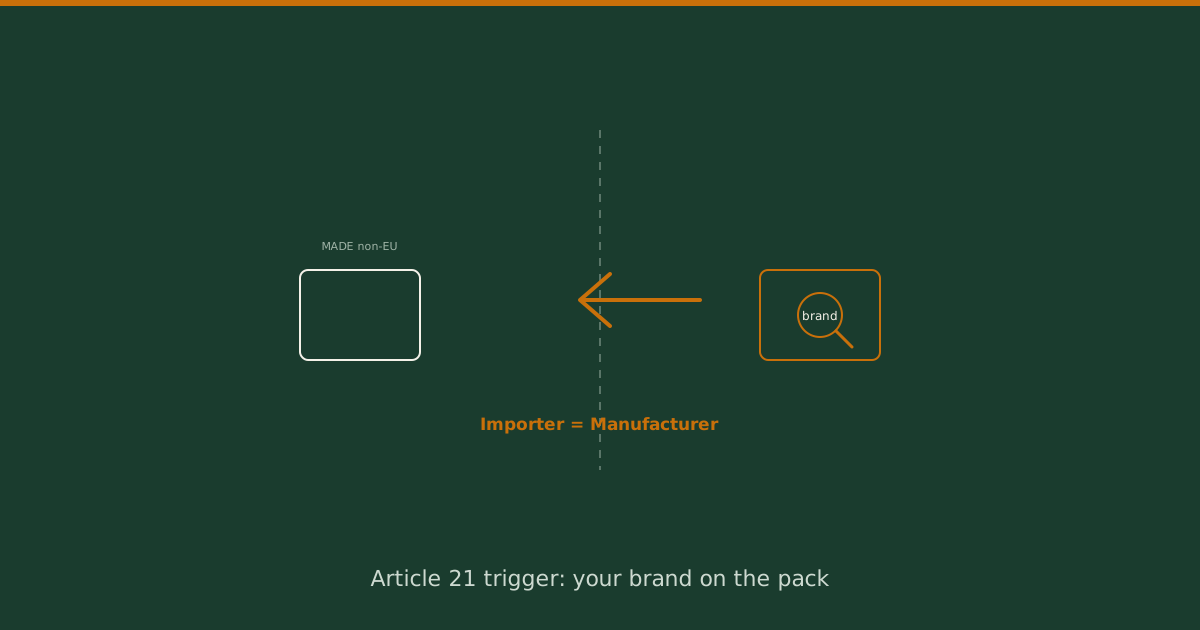
Under PPWR Article 21, an importer placing packaging on the EU market under their own name or trademark becomes the manufacturer and assumes the full set of Article 11 obligations, including issuing the Declaration of Conformity. The rule is unconditional and triggers automatically; there is no opt-out, no minimum threshold, no SME carve-out. For non-EU exporters using EU partner branding, Article 21 is the most-missed compliance risk of the 12 August 2026 deadline.
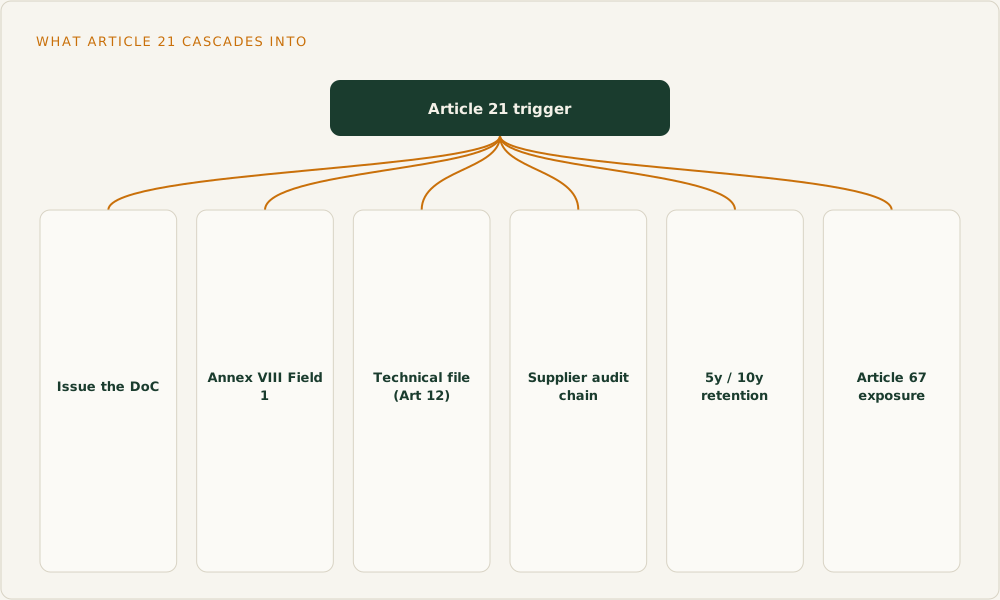
The Commission Guidance of 30 March 2026 clarified four trigger conditions. The rule applies to importers regardless of country of origin: a Turkish olive oil exporter, a Polish co-packer, a Romanian fertiliser distributor, and a UK post-Brexit importer all face the same Article 21 mechanic. The downstream implication is structural: technical file ownership, supplier audit trail, and the 5-year (single-use) or 10-year (reusable) DoC retention obligation shift from the original manufacturer to the EU-side importer. The original producer remains the technical source but no longer the regulatory issuer.
In this guide:
- What Article 21 actually says, and the 4 trigger conditions
- 4 worked scenarios across TR, PL, RO, and UK supply chains
- What changes operationally when Article 21 triggers
- The non-EU exporter compliance pathway (TR / PL / RO specifics)
- 7-entry FAQ covering trademark visibility, e-commerce, SMEs, and CBAM overlap
What Article 21 Actually Says
PPWR Article 21 of [Regulation (EU) 2025/40](https://eur-lex.europa.eu/eli/reg/2025/40/oj) states that any party placing packaging on the EU market under their own name, trademark, or modified specification is considered the manufacturer for all PPWR obligations. The rule applies regardless of importer size, country of origin, or distribution channel.
The Four Triggering Conditions (Commission Guidance 30 March 2026)
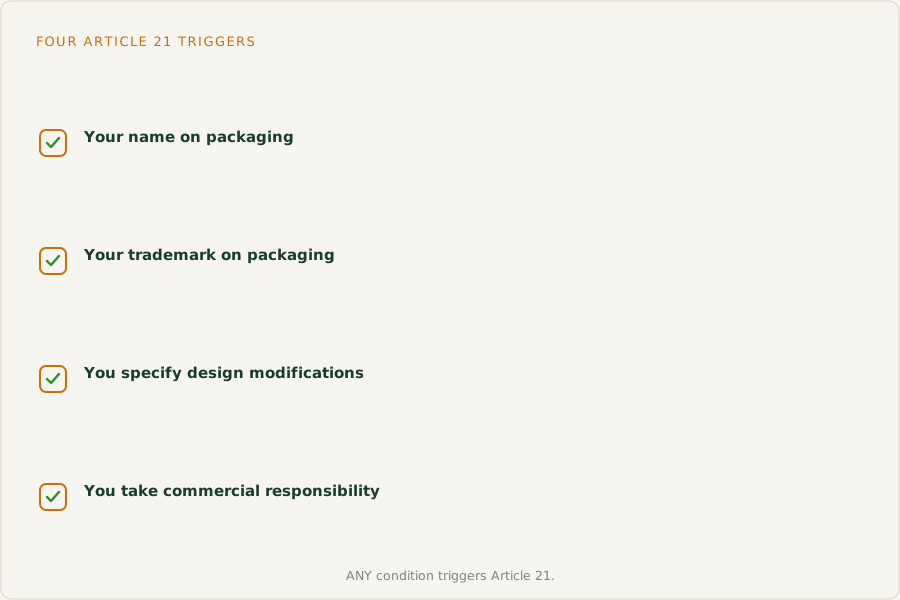
Any one of the following conditions triggers Article 21:
- The importer's name appears on the packaging. Even small text identifying the EU-side party as the brand owner is sufficient. Visibility is not a quantitative test.
- The importer's trademark appears on the packaging. Registered trademarks, unregistered marks, and trade dress all count. Private-label and white-label arrangements are squarely in scope per the Commission Guidance.
- The importer specifies modifications to the packaging design. Commissioning a non-EU producer to manufacture to the importer's specification (colour, dimensions, structural change, custom artwork) triggers the rule. The threshold is "design intent originated with the EU-side party."
- The importer places the packaging on the EU market under their commercial responsibility. This is the catch-all condition. Where the EU-side party stands behind the product commercially (warranty, complaint handling, brand promise), they bear the regulatory accountability.
Why the Rule Exists
Article 21 closes the offshoring loophole. Without it, EU brand owners could place packaging on the EU market while routing the substantive Article 5 to 12 obligations through non-EU producers outside the regulator's enforcement reach. The rule aligns with the CE marking precedent in the Machinery Directive, the Toys Directive, and the General Product Safety Regulation: the party closest to the EU consumer carries the EU-side responsibility. From the regulator's perspective, Article 21 makes the EU importer the single contact point for audit, market withdrawal, and sanction.
The rule is also pragmatic. Member State enforcement agencies do not have jurisdictional reach over non-EU producers; they do have it over EU importers and brand owners. Article 21 routes the audit conversation to a party the regulator can actually reach.
Four Worked Scenarios: Does Your Business Trigger Article 21?

Scenario 1: Turkish Olive Oil Exporter, German Retail Private Label
A Turkish olive oil producer ships glass bottles to a German discount retailer for the retailer's private-label line. The bottles are filled in Türkiye, labelled with the German retailer's brand (for example "Bio-Olivenöl" under the retailer's house mark), and shipped pre-packaged to the German distribution centre.
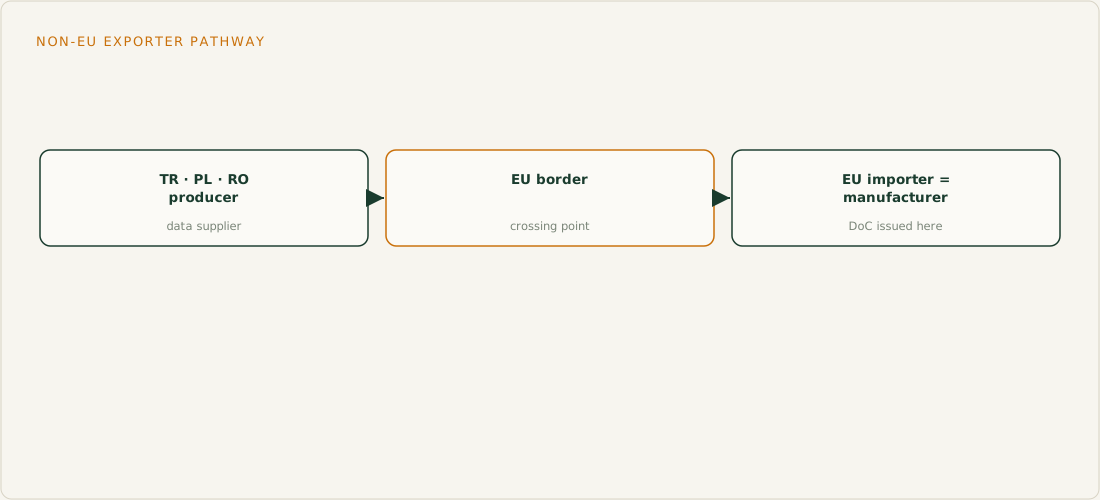
Article 21 triggers for the German retailer. The retailer becomes the manufacturer for PPWR purposes. The retailer must issue the Annex VIII DoC, hold the technical file (composition, PFAS test certificates, RecyClass assessment), maintain 5-year retention from last EU placement, and answer authority requests within 10 working days. The Turkish producer has no direct Article 11 obligation but must supply the upstream technical data the retailer needs to draft Fields 4 (composition), 7 (methodology codes), and 9 (PCR content). Commercially, the Turkish producer's compliance posture is to become the retailer's indispensable data partner; the regulatory accountability sits with the EU-side brand.
Scenario 2: Polish Co-Packer, Dutch Premium Brand
A Polish co-packer fills and caps yoghurt cups for a Dutch organic dairy brand. The cups carry the Dutch brand logo and are placed on the EU market by the Dutch brand. Article 21 triggers for the Dutch brand. The Dutch brand issues the DoC; the Polish co-packer is a supplier under the technical file.
The watch-item is parallel channels. If the Polish co-packer also supplies the same yoghurt cup unbranded (private-label-by-channel, for example to a smaller Polish supermarket chain under that chain's own brand), separate Article 21 analysis applies for each channel. Where the cup is placed on the EU market without an EU brand on it (a pure OEM contract under the Polish co-packer's name), the Polish co-packer is the manufacturer. Article 21 routes obligation per placement, not per producer.
Scenario 3: Romanian Distributor, Turkish Steel Beverage Cans
A Romanian distributor imports steel beverage cans from a Turkish can producer. The cans carry the Romanian distributor's brand and are placed on the Romanian market (and onward into the EU single market). Article 21 triggers for the Romanian distributor. The distributor issues the PPWR DoC.
This scenario also intersects with CBAM Wave 2 (entering into application from November 2026). Steel and aluminium imports are CBAM-covered goods; the packaging itself is PPWR-covered. The Romanian distributor faces dual compliance: a PPWR DoC per packaging type under Article 11, and a CBAM declaration per shipment under the CBAM regulation. These are separate documents under separate regulations, but both sit with the EU-side party. The metals-packaging overlap is walked in our CBAM and PPWR overlap guide (coming soon).
Scenario 4: UK Post-Brexit Importer into Northern Ireland
A UK-based importer brings packaged consumer goods into Northern Ireland (which under the Windsor Framework remains aligned with EU customs and product rules) and onward into the Republic of Ireland. Goods carry the UK importer's brand. Article 21 triggers for the UK importer for the NI placement.
The same UK importer placing the same goods on the GB market faces UK Packaging EPR (the Producer Responsibility regime administered by DEFRA), not PPWR. The dual-regulator environment is operationally heavier than either system alone: separate documentation, separate registration, separate fee structures. UK importers active in both NI and GB maintain parallel compliance archives. The UK side runs under the separate UK Packaging EPR regime.
What Changes When Article 21 Triggers
Annex VIII Field 1 and Field 2 Shift
The Annex VIII model has separate fields for manufacturer (Field 1) and importer (Field 2). When Article 21 triggers, the importer's data populates Field 1 (manufacturer of record). Field 2 may then be blank or carry an internal reference to the contractual supply relationship; the Commission Guidance does not require Field 2 to be repopulated with the same EU-side party. The authorised signatory in Field 12 is an officer of the importer entity, with documented signing authority.
Technical File Ownership (Article 12)
The supporting technical file (laboratory test reports, supplier composition declarations, RecyClass assessment outputs, chain-of-custody certificates for PCR content) transfers in regulatory ownership to the importer. Retention is 5 years for single-use packaging or 10 years for reusable packaging, from the date the packaging type was last placed on the EU market. The physical files can sit with the supplier under contract, but the regulator-facing responsibility to produce them on a 10-working-day request lies with the importer.
Supplier Audit Trail Requirements
Article 21 does not relieve the importer of evidencing the upstream supply chain. Quite the opposite: by becoming the manufacturer of record, the importer must hold and produce evidence that the original supplier's compliance claims are accurate. Written supplier declarations, sample test data, and supplier audit reports become standing documentation in the importer's compliance file.
Carbonorm's supplier portal helps non-EU exporters serve their EU partners with audit-ready data, and helps EU importers verify and aggregate it into Annex VIII DoCs. [See the supplier workflow](/manual/suppliers).
The Non-EU Exporter Compliance Pathway
For Türkiye (TR) Exporters
Turkish producers cannot avoid PPWR by routing through EU partners. Article 21 shifts the regulatory issuer; it does not eliminate the underlying obligation. The commercial implication is direct: the Turkish exporter's value to the EU brand partner increases when they can supply audit-ready data, and decreases when the EU partner has to extract that data through repeated supplier requests. The Sıfır Atık Yönetmeliği remains the TR domestic obligation; it does not satisfy PPWR. EU export documentation is a separate file.
Recommended posture for TR exporters: build an internal compliance data layer (composition, PFAS test sheets per food contact pack, PCR chain-of-custody certificates, RecyClass-aligned design assessments) that can be supplied to EU partners in 5 working days. The TIM exporter compliance brief is the working trade-association reference.
For Poland (PL) Co-Packers
The critical distinction for Polish co-packers is OEM-branded versus unbranded SKUs. The same physical cup can carry the German brand in one channel (Article 21 routes to the German brand) and the Polish co-packer's own brand in another channel (the Polish co-packer is the manufacturer). The compliance archive is per-channel. Customs documentation alignment with VerpackG applies for any shipment into Germany regardless of brand placement; LUCID registration is a parallel obligation.
For Romania (RO) Distributors
Romanian importers contend with three interacting frameworks. PPWR Article 21 routes the DoC obligation to the Romanian distributor for any packaging branded with their name. The local scheme is Eco-Rom Ambalaje (analogous to Citeo in France, CONAI in Italy). CBAM Wave 2 covers steel and aluminium goods entering Romania, with declarations handled through ANAF customs interfaces. The Romanian distributor maintains three documentation streams: PPWR DoC, Eco-Rom contribution, CBAM declaration. They are separate; none of the three replaces the others.
Frequently Asked Questions
Q1: Does Article 21 apply if my name is only on the packaging in small text? Yes. The Commission Guidance does not set a visibility or font-size threshold. Any brand identification placing the importer as the commercial party triggers Article 21. The test is presence, not prominence.
Q2: What if I import packaging-only (empty) into the EU? Article 21 still applies. The DoC obligation attaches to the packaging type placed on the EU market, regardless of whether it is filled or empty at the point of placement. An importer of empty PET preforms branding them for downstream sale issues the DoC.
Q3: Does Article 21 apply to e-commerce dropshippers? Yes, when the dropshipper's brand appears on the packaging or the dropshipper takes commercial responsibility. A fulfilment-only relationship without brand placement and without commercial responsibility may keep the obligation with the upstream party, but the Commission Guidance favours the catch-all "commercial responsibility" reading. Most dropship arrangements with EU-side brand visibility trigger Article 21.
Q4: Can the original manufacturer co-sign the DoC? The Annex VIII model accommodates one signatory in Field 12, an authorised representative of the manufacturer of record. Co-signing as a courtesy is not prohibited but does not reduce the legal exposure of the manufacturer of record. The regulator looks to the manufacturer of record for accountability.
Q5: How does Article 21 interact with CBAM (steel and aluminium packaging)? CBAM and PPWR are separate regimes covering different obligation surfaces. CBAM covers the carbon-intensive imported good; PPWR covers the packaging. For steel or aluminium packaging types (cans, closures), the importer faces both regimes, with separate declarations under each. See our PPWR + CBAM overlap guide for the dual-compliance detail.
Q6: Are SMEs exempt under Article 21? No. Article 21 carries no SME carve-out. The Commission Guidance reiterated that the rule applies regardless of importer size, transaction volume, or distribution channel.
Q7: Can Carbonorm help non-EU exporters supply DoC data to EU importers? Yes. The platform's supplier portal lets non-EU exporters maintain composition data, test certificates, and chain-of-custody records in audit-ready format, and lets EU importers pull that data directly into their Annex VIII DoCs. Pilot programmes are open for TR, PL, and RO exporters. Start Audit.
Conclusion: Article 21 Is a Role Flip, Not an Exemption
Article 21 is the most operationally significant single rule in PPWR for any supply chain involving non-EU production and EU brand placement. It does not exempt the non-EU producer; it shifts the regulatory issuer to the EU-side party while leaving the non-EU producer as the technical evidence source. The four trigger conditions (name, trademark, design modifications, commercial responsibility), confirmed by the Commission Guidance of 30 March 2026, make the rule's reach broad: most private-label, white-label, and OEM-branded arrangements fall inside it.
The structural consequence is that DoC issuance, technical file ownership, supplier audit responsibility, and audit-response duty all sit with the EU importer. For TR, PL, and RO exporters, the commercial implication is to become the indispensable data partner of EU brand customers. For EU importers, the implication is that the manufacturer role you have inherited under Article 21 carries the full 5-year (single-use) or 10-year (reusable) retention burden under Article 11(4).
Carbonorm supports both sides of the Article 21 split: a supplier portal for non-EU exporters maintaining audit-ready data, and an Annex VIII DoC engine for EU importers aggregating that data into compliant declarations. Start Audit; pilot programmes available for TR / PL / RO exporters.
---
Read next:
- PPWR Article 11 Declaration of Conformity →
- PPWR Annex VIII DoC Template →
- PPWR Compliance Pillar →
- Germany VerpackG Overlay →
- PPWR Article 67 Penalties →
---