PPWR Annex VIII DoC Template + Field-by-Field Guide
PPWR Annex VIII Declaration of Conformity Template + Field-by-Field Guide
Every packaging type placed on the EU market from 12 August 2026 must be backed by a signed Declaration of Conformity drawn up using the PPWR Annex VIII model template. The model is short — a single page — but every field is enforceable, and a DoC missing methodology codes or sourcing evidence will not survive regulator audit. This guide walks every Annex VIII field, with a free downloadable PPWR Declaration of Conformity template plus three worked examples (PET bottle, multilayer film, kraft mailer). Citations: EU Regulation 2025/40 Articles 11 + 38 + Annex VIII, plus the Commission Guidance and FAQ published 30 March 2026.
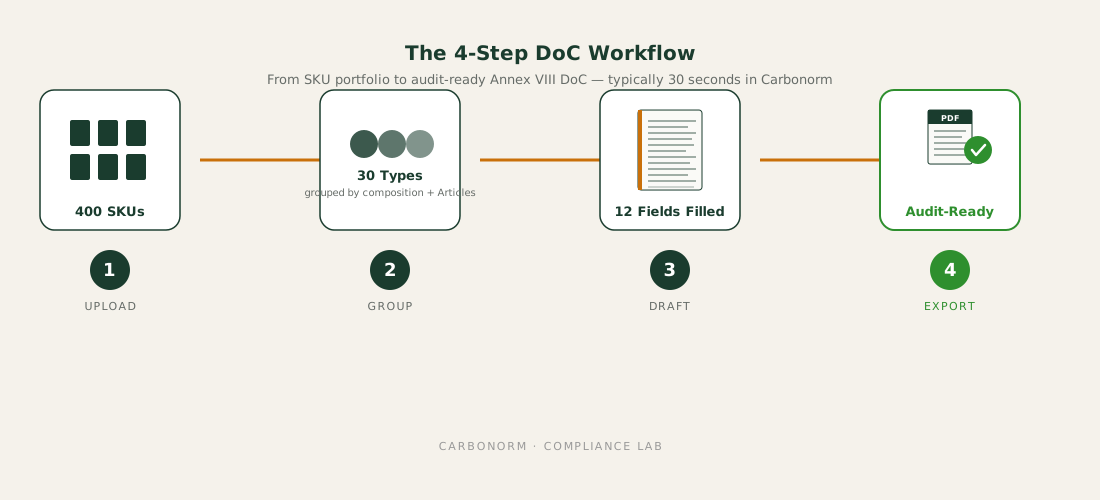
The Article 11 DoC requirement covers every "packaging type" — not every SKU. A type is defined by composition, format, function, and the Articles applicable (5–12). Producers grouping 400 SKUs into roughly 30 types still issue roughly 30 DoCs. Importers verify these DoCs and retain them; importers branding packaging with their own name become manufacturers under Article 21, and issue the DoCs themselves. Carbonorm's DoC engine auto-groups SKUs into types and generates audit-ready Annex VIII DoCs in 4 steps. This guide gives you the template if you need to draft them manually.
In this guide:
- Free Annex VIII DoC template (PDF + Word, EN + DE + TR)
- Field-by-field walkthrough with worked entries
- Retention and audit response requirements
- 3 SKU example DoCs (PET bottle, multilayer film, kraft mailer)
- DE + TR versions linked at bottom
What Is the Annex VIII Model and Why It Matters
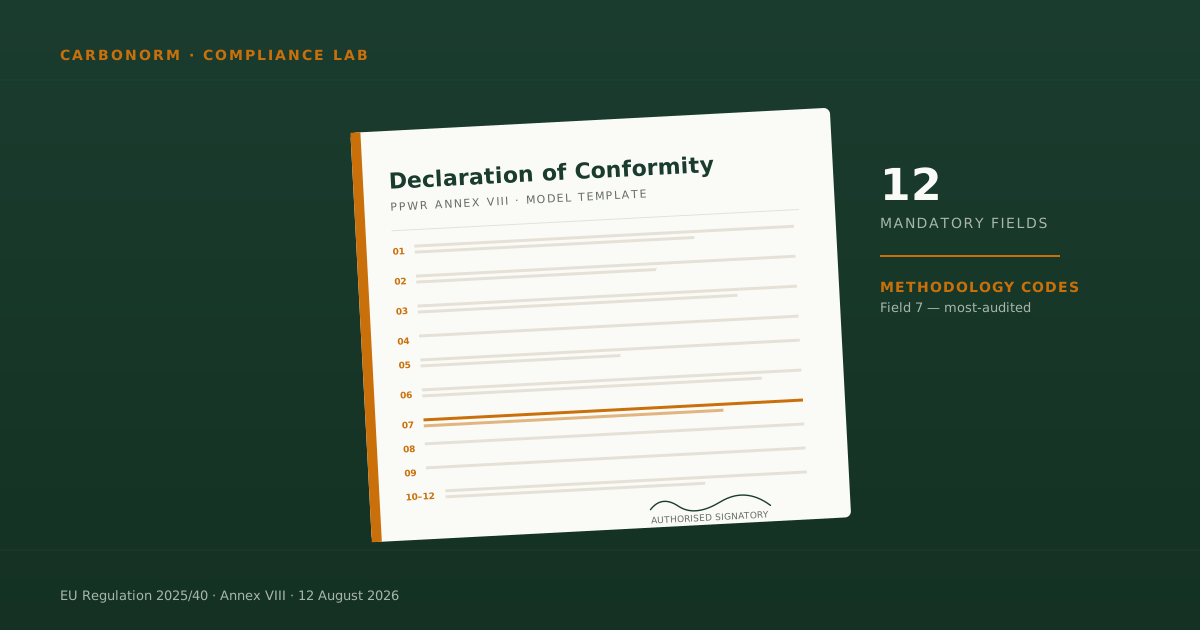
Annex VIII of [Regulation (EU) 2025/40](https://eur-lex.europa.eu/eli/reg/2025/40/oj) is the prescribed model for the Declaration of Conformity that every packaging manufacturer must issue from 12 August 2026 — a single-page artefact with 12 fields covering identification, composition, applicable Articles, methodology, and signatory.
The Article 11 Mandate
Article 11 of the regulation establishes the DoC obligation. Annex VIII provides the binding model template that the DoC must follow. Article 38 cross-references the DoC as the primary evidencing document for recyclability assessments. From 12 August 2026, packaging without a valid DoC may not be placed on the EU market. The Commission Guidance (30 March 2026) clarifies that the DoC is mandatory regardless of company size, country of origin, or distribution channel.
One DoC per "Packaging Type," Not per SKU
The Commission Guidance defines a "packaging type" as a grouping of packaging that shares composition, format, function, and the set of applicable Articles. A 400-SKU portfolio typically resolves into 25–40 distinct packaging types. Worked example: a beverage producer with 15 PET bottle sizes (250 ml through 2 litre) groups into one PET bottle "type" if composition and applicable Articles are identical. A different bottle wall thickness, sleeve material, or closure can split into separate types. See our stakeholder roles guide for which actor in the supply chain issues the DoC under different scenarios, and the Article 21 importer rule for the importer-as-manufacturer trigger.
The 12 Annex VIII Fields, Walked Through
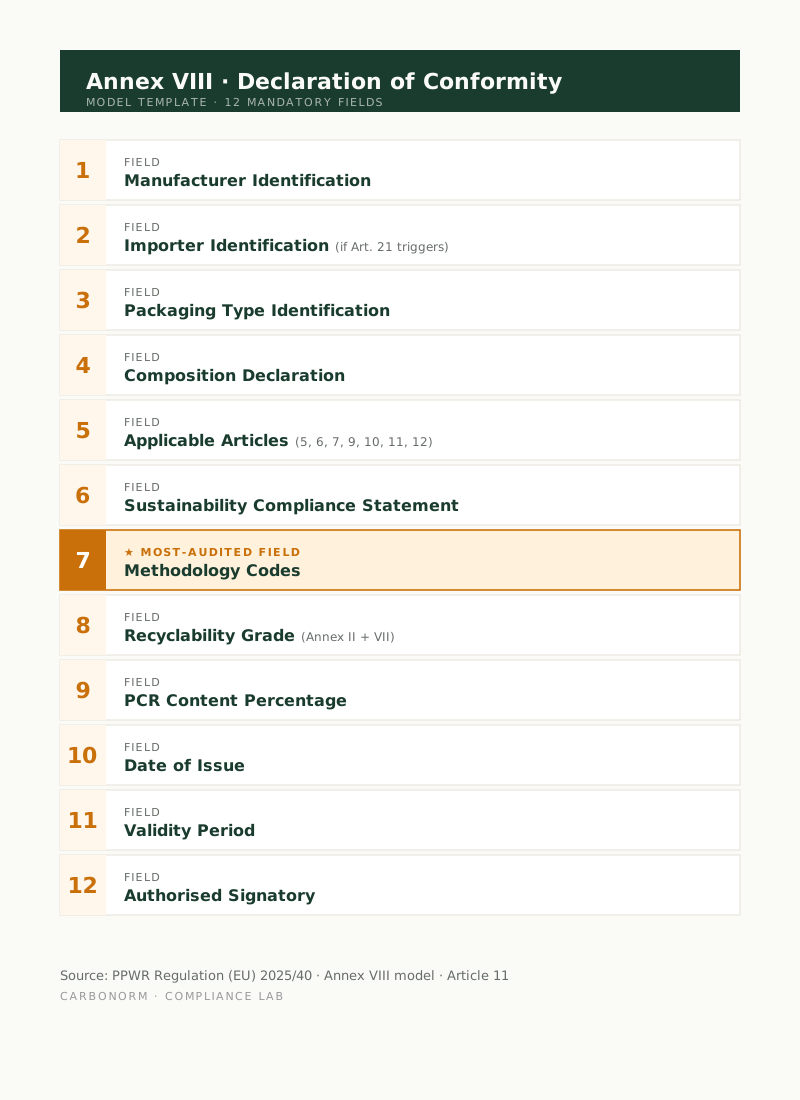
Annex VIII specifies 12 mandatory fields. Each is enforceable; a PPWR Declaration of Conformity template missing any of them is invalid.
Field 1 — Manufacturer Identification
Legal name, registered address, contact details, and (for non-EU manufacturers) the appointed EU representative under Article 19. Example entry: "Carbonorm Packaging GmbH, Pappelallee 78, 10437 Berlin, Germany. EU representative: not applicable (EU-established)."
Field 2 — Importer Identification (if Article 21 triggers)
Completed when the importer has placed the packaging under their own name or trademark. Under Article 21, the importer becomes the manufacturer and replaces Field 1 with their own data. This single rule trips most non-EU exporters using EU partner branding.
Field 3 — Packaging Type Identification
Technical name, function description, dimensions, and weight range. Example: "Mono-material PET beverage bottle, food contact, 250 ml–2 litre, wall thickness 0.3–0.5 mm, 18–32 g per unit."
Field 4 — Composition Declaration
Materials by mass percentage, with supplier reference for traceability. The composition entry must be reproducible — auditors verify by sampling. Cross-reference to material-specific guides: PET, HDPE. Multi-component packs list each layer.
Field 5 — Applicable Articles
Tick-box for each Article that applies: Article 5 (PFAS), Article 6 (recyclability), Article 7 (PCR), Article 9 (reuse), Article 10 (minimisation), Article 11 (DoC itself), Article 12 (other). A packaging type with food contact triggers Article 5; one with recycled content triggers Article 7.
Field 6 — Sustainability Compliance Statement
Standard declarative sentence from Annex VIII Section 4: "The packaging type identified above conforms to the sustainability requirements set out in Articles 5 to 12 of Regulation (EU) 2025/40." This sentence is the legal heart of the document.
Field 7 — Methodology Codes ⭐
The most-audited field. Each Article-specific claim requires a methodology code:
- Article 5 (PFAS): e.g., "EN17681-2024" for total EOF test method.
- Article 6 (recyclability): e.g., "RC-2024-A" for RecyClass 2024 guidelines, grade A.
- Article 7 (PCR): e.g., "EuCertPlast-2025" for chain-of-custody-verified PCR content.
A DoC without methodology disclosure is incomplete per Article 6 § 5 and Article 38. See our Annex II worst-of methodology deep-dive for the grading rules behind Article 6 codes.
Field 8 — Recyclability Grade
The Annex II categorical grade (A–E) AND, where available, the Annex VII quantitative grade. A pack might show "Annex II Grade A / Annex VII Score 92."
Field 9 — PCR Content
Percentage by mass, with traceability source. Example: "35 % post-consumer recycled PET, traceability via supplier EuCertPlast certificate."
Field 10 — Date of Issue
Effective date of the DoC. If superseding a prior version, reference the prior date.
Field 11 — Validity Period
The DoC remains valid until a material, process, or specification change. PPWR does not specify a fixed expiry; the DoC is event-driven, not time-driven.
Field 12 — Authorised Signatory
Name, title, and signature. Per Commission Guidance (30 March 2026), electronic signatures are acceptable. Manuscript signatures remain valid.
Three Worked SKU Examples
Each example is a real-shape Annex VIII DoC for a different packaging type. Compare the differences in composition, methodology codes, and applicable Articles.
Example 1 — Mono-Material PET Bottle
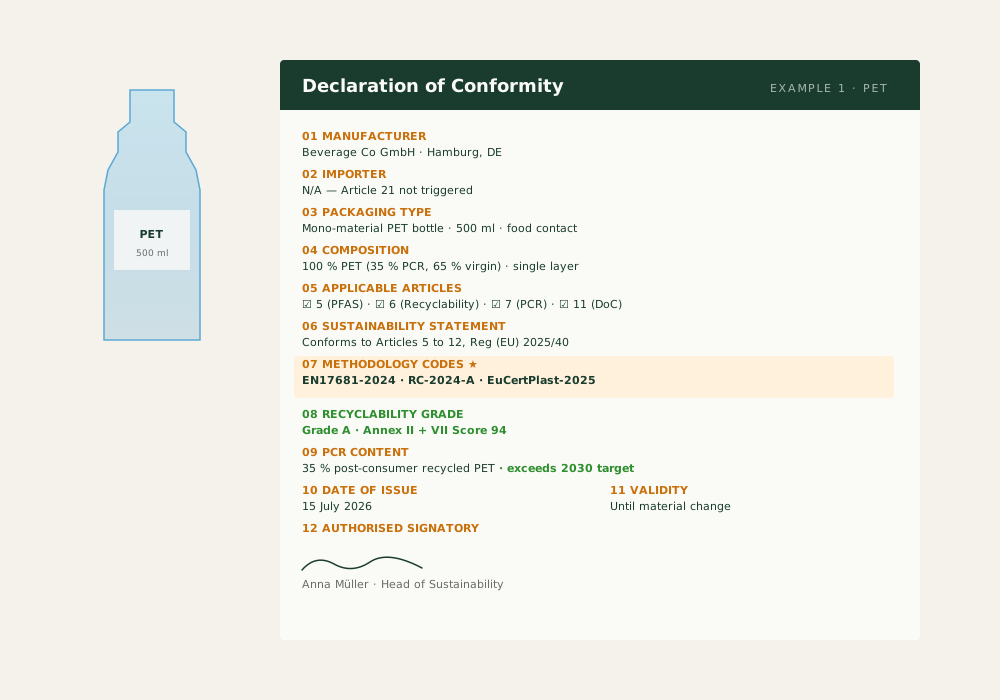
A 500 ml mineral water bottle from a DACH-region beverage producer. Composition: 100 % PET (35 % PCR, 65 % virgin). Applicable Articles: 5, 6, 7, 11. Field 7 methodology codes: "EN17681-2024" (PFAS, PFAS-free clear), "RC-2024-A" (recyclability), "EuCertPlast-2025" (PCR traceability). Field 8 Grade A. Field 9 PCR 35 % — exceeds the 30 % contact-sensitive PET threshold required by Article 7 for 2030. The producer is well ahead of deadline on this type.
Example 2 — 5-Layer Barrier Film for Cheese
A cheese packaging film: LDPE / EVOH / PE-MA / PE / LDPE. Composition: 65 % PE family, 28 % EVOH, 7 % tie layer. Applicable Articles: 6, 11 (no food contact PFAS, no PCR claim). Field 7 methodology: "RC-2024-C" (recyclability). Field 8 Grade C — the EVOH barrier triggers the Annex II worst-of rule. The whole 5-layer film inherits the worst-component grade. Field 9 PCR 0 % — flag for sourcing roadmap, as multilayer barrier films will face 2030 reuse-target pressure under Article 9.
Example 3 — Kraft Mailer for E-commerce
A single-material kraft paper e-commerce shipping mailer (300 g/m²). Composition: 100 % kraft paper, 92 % PCR fibre. Applicable Articles: 6, 11. Article 5 (PFAS) marked N/A as no fluoro-coatings present. Field 7 methodology: "FEFCO-2024-A" (FEFCO recyclability), "FSC-mix-credit" (forest origin), "EUDR-compliant" (deforestation regulation cross-reference). Field 8 Grade A. Field 9 PCR 92 % — well above any future threshold. The pack passes cleanly; the only watch-item is EUDR traceability documentation, which sits adjacent to the DoC rather than within it.
Retention, Audit Response, and Member State Variation
How Long to Keep DoCs
Under Article 11(4) of PPWR, manufacturers and importers must retain Declarations of Conformity for 5 years for single-use packaging and 10 years for reusable packaging, from the date the packaging was last placed on the EU market. The clock starts on last placement — not on issue date. For a packaging type discontinued in March 2027, single-use DoCs must be held until March 2032.
Producing DoC on Authority Demand
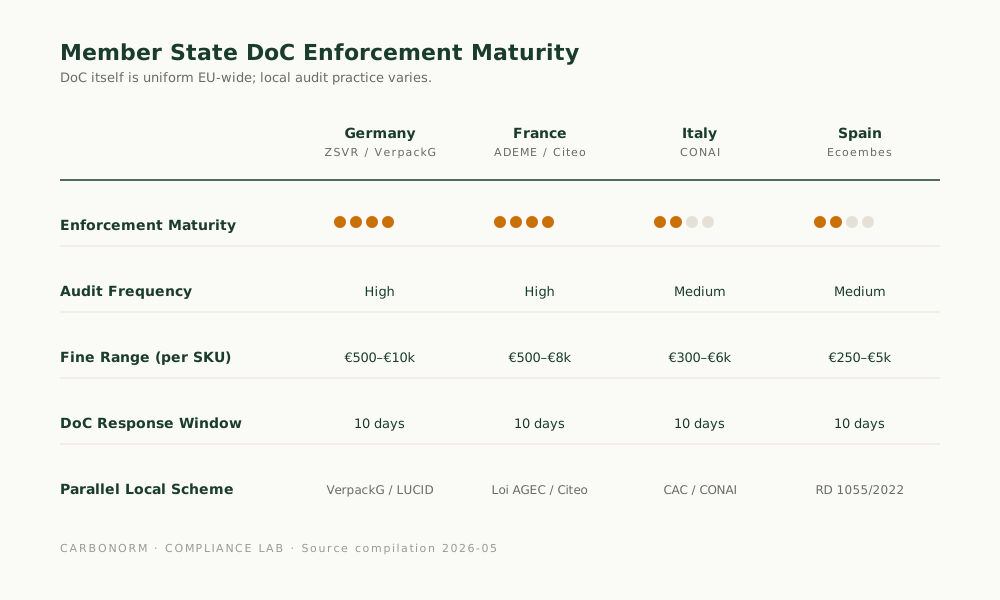
Authorities can request DoCs and must receive them within 10 working days, per Article 11(5). Acceptable formats: PDF, machine-readable XML, or the original Annex VIII model in either form. Non-response triggers escalation to Article 67 sanctions — see our Article 67 penalties deep-dive for Member State fine ranges and enforcement maturity profiles.
Member State Acceptance Variations
The DoC itself is uniform across the EU — but local enforcement practice varies. Germany (under ZSVR coordination and the parallel VerpackG regime) operates the most mature audit infrastructure and the highest documented fine ranges. France (ADEME / Citeo coordination) audits with similar rigour, especially for eco-modulation alignment. Italy (CONAI) and Spain (Ecoembes) are scaling enforcement through 2027. Eastern EU Member States are earlier on the maturity curve. Local schemes such as VerpackG / LUCID registration remain in force in parallel to PPWR — the DoC does not replace them.
FAQ — Common Annex VIII Questions
Q1: Is the Annex VIII model mandatory or is it an example? A: Annex VIII is the prescribed model. Deviations are permitted only where the deviation provides equivalent information; the Commission Guidance (30 March 2026) clarifies any required additional fields.
Q2: Can I sign a DoC electronically? A: Yes. The Commission Guidance confirms electronic signatures are acceptable under PPWR Article 11. Manuscript signatures remain valid.
Q3: Does each SKU need its own DoC? A: No. DoCs are issued per "packaging type" (composition + format + function), not per SKU. A 400-SKU portfolio typically generates 25–40 DoCs.
Q4: Can a single DoC cover multiple Member States? A: Yes. The DoC is EU-wide; no per-Member-State variation is required. Local schemes (VerpackG, Citeo, CONAI) still require separate registrations, but the DoC itself is unified.
Q5: What if a packaging type uses PFAS-free coatings but lab certificate is missing? A: A DoC without sourcing evidence for Article 5 compliance is invalid. Obtain the EN 17681 EOF test certificate from your supplier before issuing.
Q6: When does an importer issue the DoC instead of the manufacturer? A: Under Article 21, an importer placing the packaging on the EU market under their own name or trademark becomes the manufacturer and must issue the DoC themselves.
Q7: Must the DoC be in the local language? A: No. The DoC is in the language of the Member State where the packaging is first placed on the market, or in English. Subsequent Member States may not require translation.
Q8: What happens if a methodology code field is left blank? A: A DoC without methodology disclosure (Article 6 § 5 and Article 38) is considered incomplete. Regulator audit typically results in a corrective action notice; persistent non-compliance triggers Article 67 sanctions.
Q9: How does the DoC interact with VerpackG / LUCID registration? A: The DoC is a PPWR artefact; LUCID registration is a separate VerpackG obligation. Both required for the German market — the DoC does not replace LUCID.
Q10: Can Carbonorm generate Annex VIII DoCs automatically? A: Yes. Carbonorm's DoC engine groups SKUs into types, auto-fills 11 of the 12 fields from your portfolio data, and exports audit-ready Annex VIII PDFs in 4 steps. Start Audit.
Get Audit-Ready Before 12 August 2026
The PPWR Declaration of Conformity template under Annex VIII is short but consequential. The 12 August 2026 deadline is roughly 90 days away; producers without a DoC workflow have ~60 days left to set one up if they want margin for supplier outreach and audit testing. The 12 fields walked above each represent an enforceable obligation. Methodology codes (Field 7) and sustainability statements (Field 6) are the most-audited fields per Member State enforcement maturity tracking. Single-page or not, the DoC sits at the centre of every PPWR compliance file.
Download the free Annex VIII DoC template below (PDF + Word + Google Docs, EN + DE + TR versions). The template pack includes the three worked examples shown in this guide plus a methodology code reference table.
For 400+ SKU portfolios, Carbonorm groups SKUs into packaging types automatically and generates audit-ready Annex VIII DoCs in roughly 30 seconds. Start Audit — no credit card, first 50 SKUs free.
---
Read next:
- PPWR Article 11 Declaration of Conformity → — regulation context for the DoC mandate
- PPWR Annex II Worst-Of Methodology → — the grading rule behind Field 7 codes
- PPWR Article 21 Importer-as-Manufacturer → — when importers issue the DoC
---
Download the PPWR Annex VIII DoC Template
Get the audit-ready template pack used by 200+ EU packaging producers:
- ✓ Annex VIII model (PDF, Word, Google Docs)
- ✓ Three worked examples (PET bottle, multilayer film, kraft mailer)
- ✓ Methodology code reference table
- ✓ EN + DE + TR language versions
- ✓ Updated for Commission Guidance (30 March 2026)
[Email] [Download free template →]
GDPR-compliant: single-field signup, double opt-in via Resend, unsubscribe any time. We will send you the template plus three follow-up emails over 10 days.
---