Who Does PPWR Apply To? Manufacturer, Importer, Distributor Roles
Who Does PPWR Apply To? Manufacturer, Importer, Distributor Roles Explained
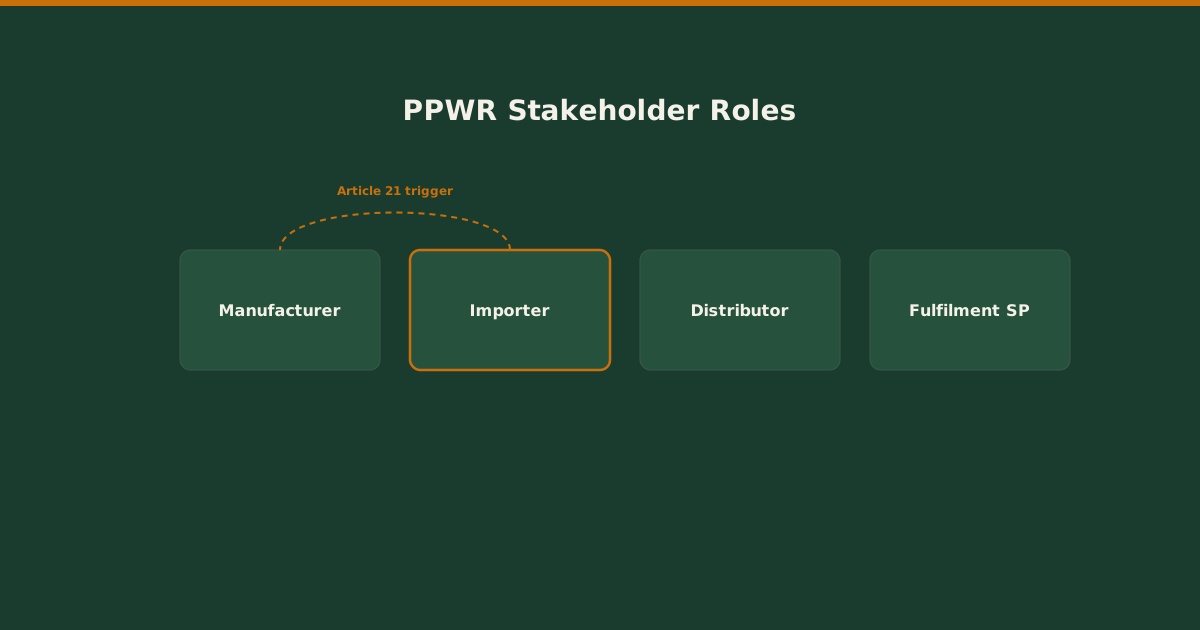
PPWR (Regulation (EU) 2025/40) covers four primary supply-chain actors plus a trigger rule that can flip one role into another. Manufacturers issue the Declaration of Conformity; importers verify and retain it; distributors refuse non-compliant packaging; fulfilment service providers carry cross-border responsibilities. Article 21 is the unconditional rule that turns an importer (or any other party) into the manufacturer for PPWR purposes when their brand appears on the packaging. This guide walks each role with concrete obligations, the decision tree to identify which one applies to you, and the multi-channel cases where a single producer can occupy more than one role across different channels.
The decision tree below is the working tool; the role descriptions explain what each role actually does. For Article 21 in depth (with four worked scenarios across TR, PL, RO, UK supply chains), see the Article 21 importer-as-manufacturer guide.
In this guide:
- The decision tree (40-second identification)
- Manufacturer obligations
- Importer obligations
- Distributor obligations
- Fulfilment service provider obligations
- Brand owners and the Article 21 trigger
- When one producer plays multiple roles
- 7-entry FAQ
The Decision Tree: Which Role Applies to You
Under PPWR, the role you carry depends on three tests: do you make the packaging, do you import it, or do you place it on the EU market under your own brand. The default rule is that the manufacturer issues the DoC. Article 21 overrides this: a party placing packaging on the EU market under their own name or trademark becomes the manufacturer for PPWR purposes, regardless of who physically produced it.
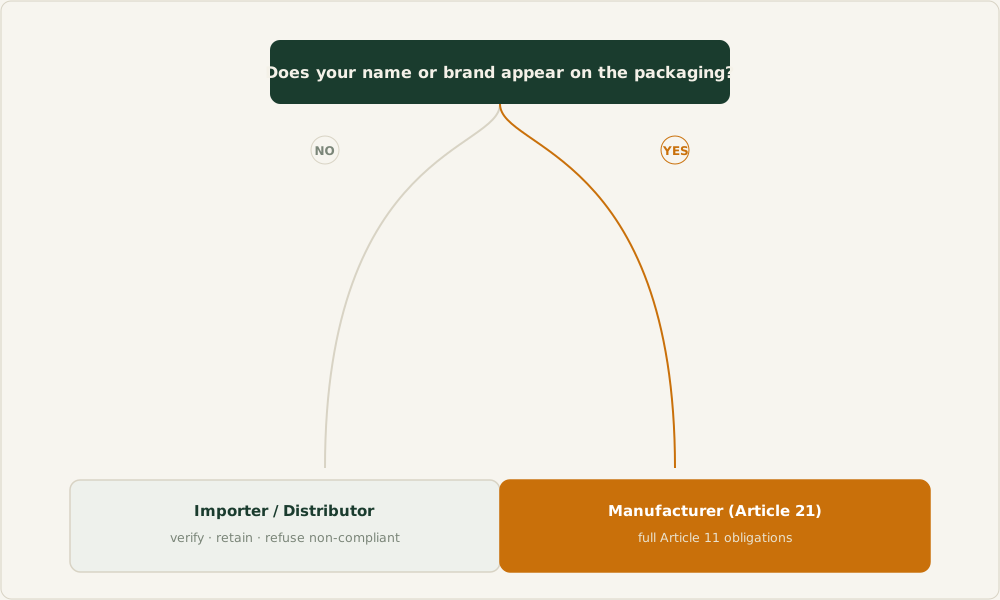
The three-question test:
- Do you place packaging on the EU market? If no, PPWR does not apply directly (but you may be the upstream supplier to a party that does).
- Does your name, trademark, or brand appear on the packaging? If yes, you are the manufacturer under Article 21, regardless of who physically produced the packaging.
- Did you produce the packaging in the EU? If yes (and Article 21 has not triggered), you are the manufacturer. If you import from outside the EU, you are the importer (unless Article 21 triggered). If you distribute downstream in the EU, you are the distributor. If you store and ship for others, you are the fulfilment service provider.
Most producers carry one role per channel and can carry different roles across different channels. The cases worked at the end of this guide cover the common patterns.
Manufacturer
The manufacturer designs and produces the packaging, places it on the EU market, and bears primary compliance responsibility under PPWR. The manufacturer is the regulator's main contact for any packaging type that carries the manufacturer's name and identification.
Core obligations:
- Issue the Annex VIII Declaration of Conformity for every packaging type placed on the EU market (Article 11, Annex VIII template)
- Maintain the technical file that evidences the conformity claim (supplier certificates, test reports, methodology documentation; Article 12)
- Grade each packaging type against Annex II using the worst-of methodology (Article 6)
- Source the recycled-content evidence required by Article 7 (chain-of-custody certificates from suppliers)
- Designate an authorised signatory with documented signing authority for Field 12 of the DoC
- Retain DoCs and technical files for 5 years (single-use) or 10 years (reusable) from last placement (Article 11(4))
- Respond to authority requests within 10 working days under Article 11(5)
A 400-SKU portfolio typically resolves into 25 to 40 packaging types, and the manufacturer issues one DoC per type. The Commission Guidance of 30 March 2026 confirmed that a type is defined by composition, format, function, and applicable Articles, not by SKU. The same composition across multiple SKU sizes consolidates into one DoC.
Importer
The importer places third-country packaging on the EU market. The default role is verification and retention rather than issuance: the importer verifies that the manufacturer has issued a valid DoC, retains a copy, and ensures the packaging carries the required identification.
Core obligations:
- Verify the manufacturer's Annex VIII DoC before placing packaging on the EU market
- Retain a copy of the DoC and supporting technical file for the same 5-year / 10-year periods as the manufacturer
- Ensure the packaging carries the required identification and labelling (Articles 15 and 16)
- Respond to authority requests for the DoC within 10 working days
- Refuse to place packaging on the market that lacks a valid DoC
Critical exception: if the importer's name, trademark, or brand appears on the packaging, Article 21 triggers and the importer becomes the manufacturer for PPWR purposes. The default verification-and-retention role does not apply; the importer issues the DoC themselves and carries the full manufacturer obligation. Private-label and white-label arrangements fall inside this rule per the Commission Guidance of 30 March 2026.
Distributor
The distributor places packaging downstream within the EU after the manufacturer or importer has placed it on the EU market. The role is the lightest of the four in terms of direct obligation, but failure to handle the role correctly can interrupt the entire downstream channel.
Core obligations:
- Refuse to handle packaging not accompanied by a valid Annex VIII DoC from the upstream manufacturer or importer
- Verify that the packaging carries the required identification and labelling
- Cooperate with authority audit requests by routing them to the upstream responsible party
The distributor does not issue DoCs and does not maintain technical files. The role functions as a downstream verification gate: a distributor handling non-compliant packaging is itself liable under Article 67, so the verification gate has commercial teeth.
Distributors should not be confused with retailers selling to consumers; retailers handling packaging that has already entered the EU market typically operate under the distributor framework. Pure logistics providers without commercial responsibility for the packaging fall under the fulfilment service provider role.
Fulfilment Service Provider
The fulfilment service provider stores, packs, addresses, or dispatches packaging on behalf of others. The role gained prominence with e-commerce growth and was formalised in PPWR as a distinct stakeholder category to close cross-border enforcement gaps.
Core obligations:
- Cooperate with authority audit requests by identifying the upstream responsible party for any packaging in the FSP's custody
- Verify reasonable indicia of compliance (DoC presence, identification on the packaging) before handling, particularly for cross-border shipments
- Refuse to ship packaging that lacks indicia of compliance for the destination EU market
The FSP does not issue DoCs, does not maintain technical files, and does not become the manufacturer under any default rule. However, FSP-mediated e-commerce flows often involve brand owners whose name appears on the packaging, which triggers Article 21 for those brand owners. The FSP role itself remains light; the brand owner role overlaid on it can be heavy.
Brand Owners and the Article 21 Trigger
Article 21 is the rule that reshapes the supply-chain map for most modern packaging arrangements. The rule states that any party placing packaging on the EU market under their own name, trademark, or modified specification is considered the manufacturer for PPWR purposes. The rule has no opt-out, no SME carve-out, and no threshold.
The four trigger conditions (any one suffices):
- The party's name appears on the packaging.
- The party's trademark appears on the packaging.
- The party specified modifications to the packaging design.
- The party placed the packaging on the EU market under their commercial responsibility.
The Commission Guidance of 30 March 2026 broadened the reading: private-label, white-label, and any visible EU brand placement triggers the rule, not only formal trademark registration. Most retail private-label arrangements (Aldi, Lidl, Rewe house brands; Carrefour Maison; Tesco Finest; Albert Heijn private label) fall squarely inside Article 21.
Practical consequence: the EU-side brand owner becomes the manufacturer of record. The non-EU supplier continues as the technical data source (composition, methodology codes, test certificates), but the regulatory issuer of the DoC is the EU brand. Audit response, retention, and Article 67 exposure all sit with the EU brand owner.
For exporters in TR, PL, RO, UK, and other non-EU origin countries, the implication is direct: become the EU brand partner's indispensable data supplier. The commercial position requires producing audit-ready upstream data on short notice. The Article 21 deep-dive walks four worked scenarios with the operational handover process.
When One Producer Plays Multiple Roles
Most producers carry a single role per channel, but multi-channel operations often produce different roles across different channels for the same physical packaging type.
Common multi-role patterns:
- Manufacturer + Distributor. A German producer manufactures cardboard mailers and also distributes them within Germany. Manufacturer role for the placement; distributor role for downstream handling. Both apply to the same physical pack.
- Manufacturer + Importer. A Dutch packaging firm manufactures locally and also imports a complementary product line from Asia. Manufacturer role for the locally produced lines; importer role for the imported lines (with Article 21 triggering if their brand appears).
- Importer + Brand owner under Article 21. A Polish company imports unbranded cups from Türkiye and applies their own brand inside the EU before placing on the market. Importer at the border, manufacturer of record under Article 21 once the brand is applied.
- Distributor + Fulfilment service provider. An e-commerce operator both distributes their own branded products (distributor role, with Article 21 on the brand) and provides fulfilment for third-party sellers (FSP role for those products).
For each role-channel pair, the obligations apply independently. A single producer's compliance file aggregates the role-specific obligations into a single retention archive but routes each obligation to the correct framework.
What Each Role Must Do: Cheat Sheet
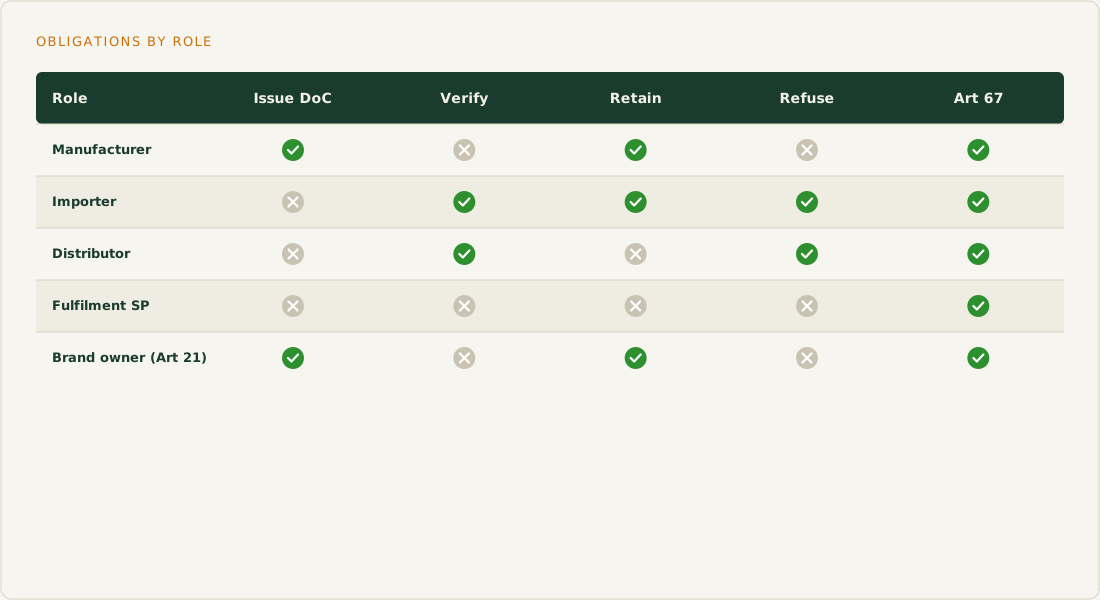
| Obligation | Manufacturer | Importer | Distributor | FSP | Brand owner (Article 21) |
|---|---|---|---|---|---|
| Issue Annex VIII DoC | ✅ | ✅ | |||
| Verify upstream DoC | ✅ | ✅ | ✅ | ||
| Retain DoC 5y / 10y | ✅ | ✅ | ✅ | ||
| Refuse non-compliant packaging | ✅ | ✅ | ✅ | ✅ | |
| Respond to audit within 10 days | ✅ | ✅ | ✅ | ||
| Article 67 fine exposure | High | Medium | Low | Low | High |
| Maintain technical file | ✅ | Partial | ✅ | ||
| Designate authorised signatory | ✅ | ✅ |
The brand owner column under Article 21 mirrors the manufacturer column exactly; the rule is a routing change, not a relief.
Frequently Asked Questions
Q1: I am a German retailer selling my own private-label products. Which role applies? Under Article 21, you are the manufacturer for PPWR purposes. The non-EU or EU supplier physically producing the packaging remains your technical data source, but you issue the Annex VIII DoC, hold the technical file, and respond to authority audits. Private-label is the most common Article 21 trigger pattern across the EU retail sector.
Q2: I import packaging from China for resale within the EU under the original Chinese brand. Which role applies? You are the importer in the default role. Because the Chinese brand (not yours) appears on the packaging, Article 21 does not trigger. You verify the manufacturer's DoC, retain a copy, and refuse to place packaging that lacks valid documentation. Practical note: many non-EU suppliers do not yet have PPWR DoCs in place; your verification responsibility means securing the DoC from them before placement.
Q3: I am a Turkish exporter selling olive oil in PET bottles to an EU brand under their private label. What is my role? You are the technical data supplier, not a PPWR-regulated actor in your own right. The EU brand owner becomes the manufacturer under Article 21 and issues the DoC. Your commercial position requires producing audit-ready data (composition, PCR content, methodology codes) on short notice. The Article 21 deep-dive walks the exporter compliance posture.
Q4: We provide fulfilment services for multiple e-commerce sellers. Are we exposed to PPWR fines? As a fulfilment service provider, your direct exposure is light: you cooperate with authority requests and refuse to ship packaging lacking reasonable indicia of compliance. The sellers whose products you fulfil bear the manufacturer or importer obligations. However, some of those sellers may trigger Article 21 if their brand appears on the packaging, and your operational role still requires verifying indicia at the cross-border handover.
Q5: We are a distributor that also re-labels some products with our own brand. Does that change our role? Yes, on the re-labelled products. The moment your brand appears on the packaging, you trigger Article 21 and become the manufacturer for those products. For products you distribute without re-labelling, you remain a distributor. The compliance file separates the two product groups into different role categories with different obligations.
Q6: Does PPWR apply to me if I only sell within one Member State? Yes. PPWR is directly applicable across all 27 EU Member States. The substantive obligations are the same in Germany, France, or any other Member State. National schemes (VerpackG, Citeo, CONAI, Ecoembes) operate in parallel with their own additional national obligations, but PPWR itself applies uniformly. The Germany VerpackG guide walks the dual-compliance pathway for the German market.
Q7: Is there an SME exemption for any of these roles? No. PPWR carries no SME carve-out, no minimum volume threshold, and no exemption by country of origin. The Commission Guidance of 30 March 2026 reiterated this explicitly. Small producers and large producers carry the same obligations within each role, although the absolute compliance work scales with portfolio size.
Conclusion
PPWR routes obligations through five roles: manufacturer (issues DoC), importer (verifies and retains), distributor (refuses non-compliant), fulfilment service provider (cooperates with audits), and the Article 21 brand owner (inherits the full manufacturer obligation). The decision tree at the top of this guide identifies which role applies to you in 40 seconds; the cheat-sheet matrix lists the per-role obligations in one view. The Article 21 trigger is the most consequential single rule for most modern packaging arrangements because it routes regulatory accountability to the EU-side brand owner regardless of where the packaging was physically produced.
Once your role is identified, the next-step destinations are the role-specific guides. Manufacturers and Article 21 brand owners go to the Annex VIII DoC template for the practical artefact, then the 90-day readiness plan for the operational sprint. Importers and distributors go to the Article 21 deep-dive to check trigger conditions, then the same readiness plan if Article 21 has triggered.
Carbonorm runs the role-specific workflow end-to-end: Annex VIII DoC generation for manufacturers and Article 21 brand owners, verification and retention workflows for importers and distributors, supplier portal for non-EU exporters serving EU brand partners. Start Audit; 50 SKUs free, no card required.
---
Read next:
- PPWR Article 21 Importer-as-Manufacturer →
- PPWR Article 11 Declaration of Conformity →
- PPWR Annex VIII DoC Template →
- What Is PPWR? Plain-English Overview →
- PPWR Compliance Pillar →
- 90-Day PPWR Readiness Plan →
- PPWR Article 67 Penalties →
---