PPWR Compliance: Complete Guide to EU Regulation 2025/40
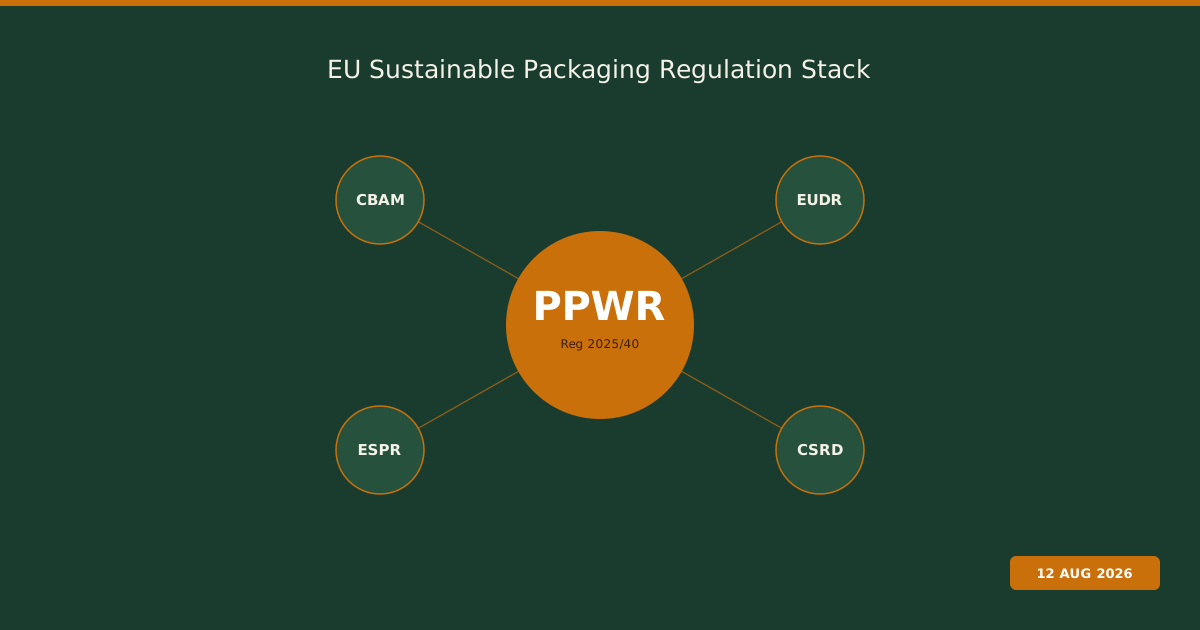
The Complete PPWR Compliance Guide
The Packaging and Packaging Waste Regulation (Regulation (EU) 2025/40), known as PPWR, applies from 12 August 2026 and replaces Directive 94/62/EC across all 27 EU Member States. From that date, every packaging type placed on the EU market must be backed by a signed Declaration of Conformity following the Annex VIII model, graded against Annex II recyclability criteria, and traceable to the Articles applicable to its composition. The Commission Guidance and FAQ published on 30 March 2026 clarified the operational reach: the regulation applies regardless of company size, country of origin, or distribution channel, and an importer who places packaging on the EU market under their own brand becomes the manufacturer under Article 21.
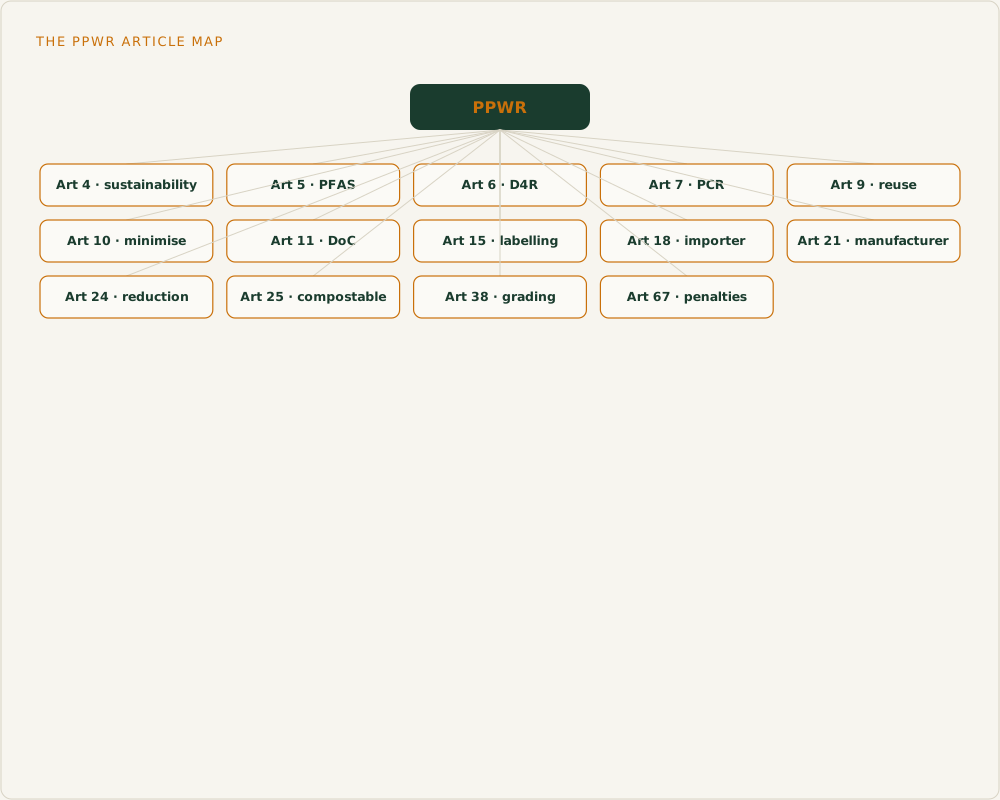
This guide is the operational reference for the regulation. It walks every substantive Article that producers will be audited against (5, 6, 7, 11, 21, 67), the full deadline cascade through 2030, the role each actor plays in the supply chain, the Commission Guidance updates of March 2026, and the Member State implementation overlay (VerpackG, Citeo, CONAI, Ecoembes, Afvalfonds). Every claim is cited to the regulation, to a recognised body, or to a primary source. Use it as the entry point; each Article links to a deeper guide.
In this guide:
- What PPWR requires and who is in scope
- Full deadline cascade from 12 August 2026 through 1 January 2030
- Per-Article obligations (Articles 5, 6, 7, 11, 21, 67) with cluster links
- Commission Guidance 30 March 2026 updates
- Member State implementation overlay
- Frequently asked questions (10 entries, FAQ-schema indexed)
- The 90-day path to audit readiness
What PPWR Requires: Regulation Overview
PPWR (Regulation (EU) 2025/40) is the directly-applicable EU regulation that sets sustainability, recyclability, recycled-content, labelling, and reuse requirements for every type of packaging placed on the EU market from 12 August 2026, replacing Directive 94/62/EC and applying uniformly across all Member States without national transposition.
Adoption, Entry into Force, Application
The regulation was adopted on 19 December 2024, entered into force on 11 February 2025, and applies from 12 August 2026. The 18-month transition window was deliberate: it gives producers time to revise material specifications, secure recycled-content supply, generate Declarations of Conformity, and align labelling. The window is short for portfolios above 200 SKUs, which is why most large producers began the audit cycle in 2025.
Replacement of Directive 94/62/EC
PPWR replaces the Packaging and Packaging Waste Directive 94/62/EC in full. The shift from Directive to Regulation is significant: a Directive is transposed into national law (and so varies across the EU); a Regulation applies directly and uniformly. Member State schemes that predate PPWR (VerpackG in Germany, Triman/Loi AGEC in France, CONAI in Italy, Ecoembes in Spain) remain in force for the obligations they uniquely cover (national registration, eco-modulation, take-back logistics), but the substantive sustainability requirements come from PPWR. The DoC is uniform; local registrations are not.
Scope: Every Actor, Every Packaging Type
PPWR covers every actor in the packaging value chain: manufacturers, importers, distributors, fulfilment service providers, and (under Article 21) brand owners. Every packaging type is in scope, from primary consumer packaging (PET bottles, kraft mailers, multilayer films) through transport packaging (corrugated cases, pallet wraps) and grouped packaging (multipacks, shelf-ready trays). The single test for scope is "is it placed on the EU market": if yes, PPWR applies.
Deadline Cascade Through 2030
The 12 August 2026 deadline is the start, not the end. PPWR enforcement phases through six milestones over four years.
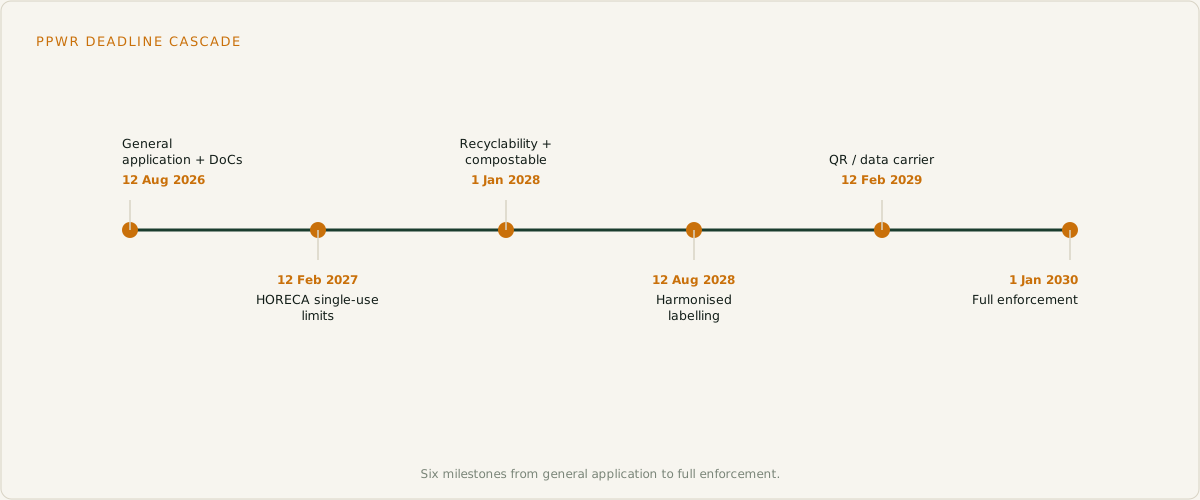
Snippet-Ready Cascade Table
| Date | Event | Stakeholder action |
|---|---|---|
| **12 August 2026** | PPWR general application; DoCs mandatory; Annex II grading required | Manufacturers issue Annex VIII DoCs for every type placed on the market |
| **12 February 2027** | HORECA single-use packaging restrictions; cup and container reuse targets begin reporting | HORECA suppliers, distributors, and brand owners align with reuse formats |
| **1 January 2028** | Recyclability criteria sharpen; compostable packaging requirements apply | Material substitutions for any grade D or E packaging; compostable EN 13432 evidence |
| **12 August 2028** | Harmonised labelling specifications apply | Update artwork (material code, sorting pictogram) across SKU portfolio |
| **12 February 2029** | Digital Product Passport: QR-code disclosure on packaging | Per-type QR generation linking to composition, methodology, DoC reference |
| **1 January 2030** | Full enforcement: grade D/E restrictions, PCR thresholds binding, reuse targets binding, packaging minimisation rules | Restrict grade D/E placements; meet 30% PCR for contact-sensitive PET; document reuse share |
Each milestone is binding. Member States may add national deadlines for adjacent schemes (LUCID registration in Germany, Triman update in France), but the EU-wide cascade above is the regulation's own.
Reading the Cascade
The 2026 date is regulation-level: it activates Articles 5 through 12 in their initial form. The 2030 date is the cliff edge: from that day, packaging of grades D and E that does not meet specific exceptions cannot be placed on the EU market, the 30% post-consumer recycled content threshold applies to contact-sensitive PET, and reuse targets become binding for several formats. The intervening dates (2027, 2028, 2029) are the operational schedule for labelling, formats, and disclosure. A 400-SKU portfolio typically needs work at every milestone, but the 2026 and 2030 dates are the hard ones.
Producers planning sequenced compliance work should anchor on the 90-day readiness plan (the operational sprint to 12 August 2026) and then schedule the 2027 to 2030 cascade as a multi-year roadmap.
Who PPWR Applies To: Article 21 and the Importer-as-Manufacturer Rule
PPWR distinguishes four supply-chain actors: manufacturer, importer, distributor, and fulfilment service provider. Each has obligations, but Article 21 changes who issues the Declaration of Conformity under a common commercial pattern.
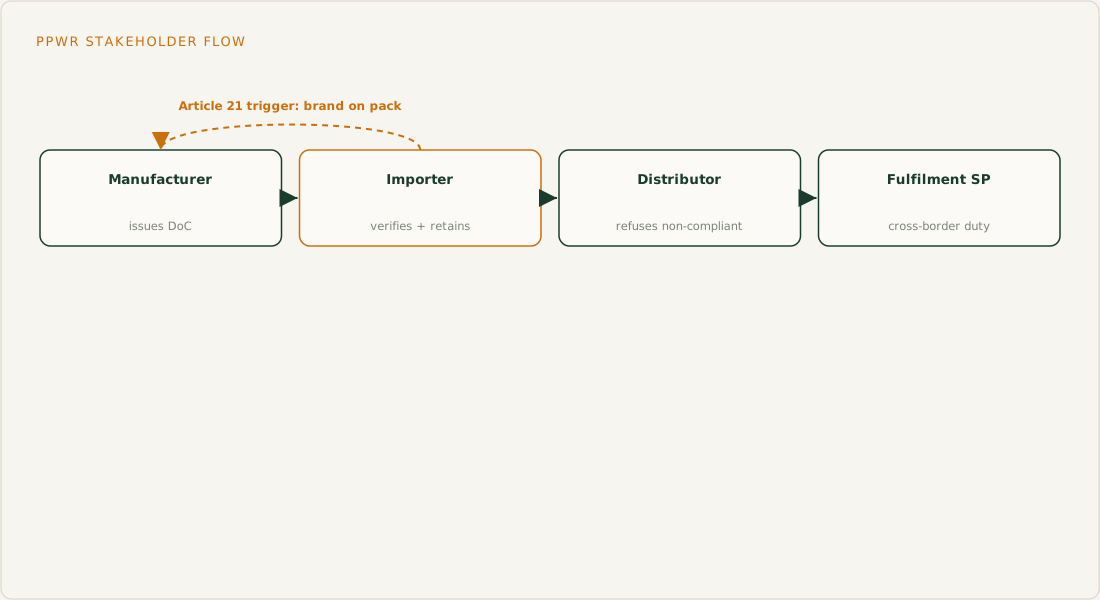
The Four Roles in PPWR
- Manufacturer. Designs and produces the packaging. Issues the Annex VIII DoC, retains the technical file, and bears primary compliance responsibility.
- Importer. Places third-country packaging on the EU market. Verifies that the manufacturer has issued a valid DoC, retains a copy, and ensures the packaging carries the required identification and labelling.
- Distributor. Places packaging downstream within the EU. Refuses to distribute packaging that is not accompanied by a valid DoC.
- Fulfilment service provider. Stores, packs, addresses, or dispatches packaging on behalf of others; carries cross-border distribution obligations, especially for e-commerce flows.
Article 21: When the Importer Becomes the Manufacturer
Article 21 of the regulation states that an importer (or any other person) who places packaging on the EU market under their own name or trademark assumes the obligations of the manufacturer. The Commission Guidance of 30 March 2026 confirmed and broadened this reading: even private-label and white-label arrangements trigger Article 21 if the EU-side party's brand appears on the packaging.
Worked example: a Polish food brand sources kraft mailers from a Turkish supplier. The mailers carry only the Polish brand's logo when sold in Germany. Under Article 21, the Polish brand becomes the manufacturer for PPWR purposes and must issue the Annex VIII DoC, not the Turkish supplier. The Turkish supplier remains a contractual party but does not bear the regulatory obligation.
This rule changes the supply-chain audit map for most non-EU exporters using EU brand partners. The deep-dive is in our Article 21 importer-as-manufacturer guide, which walks the trigger conditions, three worked scenarios, and the documentation handover process between non-EU supplier and EU brand.
Commission Guidance 30 March 2026: What Changed
The Commission published its first round of operational guidance and FAQs on 30 March 2026 (press release IP/26/664). The document was the first authoritative update since the regulation entered into force, and clarified four operational points that were ambiguous in the original text.
"Packaging type" defined operationally. The DoC is issued per packaging type, where a type is a grouping of packaging that shares composition, format, function, and the set of Articles applicable. A 400-SKU portfolio typically resolves into 25 to 40 types.
Electronic signatures accepted. The Commission confirmed that electronic signatures on the Annex VIII DoC are acceptable under Article 11. Manuscript signatures remain valid; the practical implication is that DoC workflows can run end-to-end digitally.
Article 21 formalised for private label. The guidance broadened the importer-as-manufacturer trigger to any EU brand placement on the packaging, not only formal trademark registration. Private-label arrangements are squarely in scope.
FAQ location. The Commission FAQ companion document is hosted on the DG Environment website and is updated periodically. Treat it as the working operational reference alongside the regulation text and the EUR-Lex consolidated version.
The 30 March 2026 publication is the freshest authoritative source as of this guide's date. Future guidance rounds are expected ahead of 12 August 2026 and following the first wave of Member State enforcement actions.
Article 5: PFAS and Substances of Concern in Food Contact
Article 5 restricts per- and polyfluoroalkyl substances (PFAS) in food-contact packaging and lists categories of substances of concern subject to migration limits. From 12 August 2026, food-contact packaging cannot contain PFAS above the regulation's threshold. Compliance evidence is the EN 17681 test method (extractable organofluorine, EOF) or equivalent recognised method.
Producers source supplier certificates declaring PFAS-free coatings, retain those certificates in the technical file, and reference the methodology code in Field 7 of the Annex VIII DoC. The European Food Safety Authority's (EFSA) Tolerable Weekly Intake for the PFAS sum drove the threshold; the regulation's drafters made it explicit. Tightening below the current threshold ahead of 2030 is on the policy radar; our PFAS deep-dive tracks the EFSA review status and the supplier substitution options.
Article 6: Design for Recycling and Annex II Grading
Article 6 requires every packaging type to be designed for recycling and graded on a five-point scale (A through E) using the Annex II methodology. Grade D and E packaging may not be placed on the EU market from 1 January 2030, subject to limited exceptions.
The Annex II methodology applies a worst-of rule: the lowest-scoring component determines the grade of the whole pack. A PET bottle (grade A as monomaterial) with a PVC sleeve (grade E as a disruptor for the PET stream) is graded E. A 5-layer film with one non-recyclable layer is graded as if it were that layer throughout. This rule is decisive for multilayer constructions and adhesive labels.
RecyClass is the recognised certification body operating Annex II-aligned design-for-recycling assessments. Producers obtain RecyClass certification on a packaging-type basis, reference the methodology code (RC-2024-A, RC-2024-B, etc.) in Field 7 of the DoC, and update assessments when material specifications change. The methodology and edge cases (multimaterial flexible packaging, label adhesive interaction, sleeve compatibility) are walked in our Annex II worst-of methodology guide.
Article 7: Recycled Content Thresholds
Article 7 sets binding post-consumer recycled (PCR) content thresholds by polymer family, with phased application from 2030 and 2040. Contact-sensitive PET packaging must reach 30% PCR by 1 January 2030 and 50% by 2040. PE and PP food-contact applications carry different (lower) initial thresholds. Non-contact applications carry higher thresholds.
The PCR content is calculated by mass per packaging type. Traceability evidence is chain-of-custody certification: EuCertPlast for plastics or equivalent recognised body. The chain-of-custody certificate covers the recycler and the converter; the producer retains a copy in the technical file and references the methodology code in Field 7 of the DoC.
Practical implication: supplier supply for 30% contact-sensitive PCR PET is tight through 2028, and producers who lock in supply contracts early (2025-2026) carry less specification risk through 2030. Sourcing strategies, alternative resin families, and the implications of the "mass balance" accounting approach are addressed in our Article 7 recycled content deep-dive.
Article 11: Declaration of Conformity
Article 11 requires the issuing of a Declaration of Conformity for every packaging type placed on the EU market from 12 August 2026, following the Annex VIII model. The DoC is the central artefact of PPWR compliance: it identifies the manufacturer (or importer-as-manufacturer under Article 21), specifies the packaging type, lists the Articles applicable, names the methodology codes, declares the recyclability grade and PCR content, and is signed by an authorised representative of the responsible party.
DoCs are retained for 5 years for single-use packaging and 10 years for reusable packaging from the date the packaging was last placed on the EU market. Authorities can request DoCs and must receive them within 10 working days under Article 11(5). The Commission Guidance of 30 March 2026 confirmed electronic signature acceptability.
The 12 Annex VIII fields, three worked examples (PET bottle, multilayer film, kraft mailer), retention rules, and the free downloadable template are walked in our Annex VIII DoC template guide. The Article 11 page covers the regulation context (mandate text, Article 38 cross-reference, audit response protocol).
Article 67: Penalties Overview
Article 67 requires Member States to set "effective, proportionate, and dissuasive" penalties for PPWR non-compliance. The regulation does not prescribe penalty amounts directly; each Member State sets its own fine framework within national enforcement law.
Published fine ranges vary widely. Germany (under the parallel VerpackG regime and the planned PPWR enforcement legislation) carries fines into six figures for documented audit failures; France (ADEME / Citeo coordination) operates similar maxima; Italy, Spain, and the Netherlands publish lower ceilings. Eastern EU Member States are still in the process of setting fine schedules, expected in 2026 to 2027.
Beyond fines, the regulation provides for market withdrawal (non-compliant packaging removed from sale), corrective-action notices (period to remediate), and (in cases of repeated wilful non-compliance) criminal referral. Many producers focus only on fine ranges; the market-withdrawal exposure is more operationally consequential because it interrupts production. The country-by-country fine matrix, the corrective-action timeline, and the practical CFO-level risk register are walked in our Article 67 penalties guide.
Member State Implementation Overlay
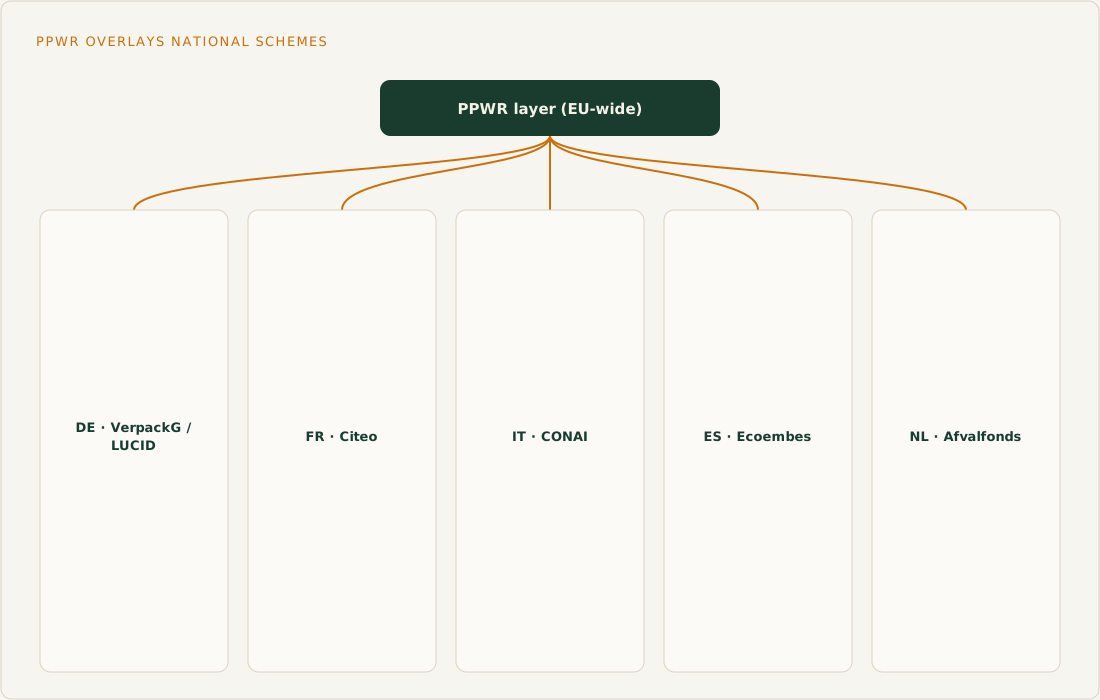
PPWR is directly applicable, but it overlays national schemes that already cover EPR (extended producer responsibility) financing, take-back logistics, eco-modulation, and national registration. The DoC and Annex II grading are uniform across the EU; the surrounding national obligations vary.
Scheme Overlay by Member State
| Member State | National scheme | Authority | Registration | Status |
|---|---|---|---|---|
| **Germany** | VerpackG | ZSVR via LUCID | LUCID registration mandatory | PPWR overlays; VerpackG remains |
| **France** | Loi AGEC + Triman | ADEME via Citeo | Citeo eco-organisme registration | PPWR overlays; AGEC remains |
| **Italy** | CONAI scheme | CONAI | CONAI contribution + declaration | PPWR overlays; CONAI remains |
| **Spain** | Royal Decree 1055/2022 | MITECO via Ecoembes | Ecoembes registration | PPWR overlays; RD 1055 remains |
| **Netherlands** | Afvalfonds Verpakkingen | Afvalfonds | Afvalfonds declaration | PPWR overlays; Afvalfonds remains |
Germany: VerpackG and LUCID
Germany operates the most mature EPR enforcement infrastructure in the EU. The Verpackungsgesetz (VerpackG) requires LUCID registration with the Zentrale Stelle Verpackungsregister (ZSVR) for any producer placing packaging on the German market. PPWR does not replace VerpackG; both are required. The DoC sits in the PPWR file; the LUCID registration sits in the VerpackG file. ZSVR audits target both. Our Germany VerpackG guide walks the LUCID registration steps, the eco-modulation tariff structure, and the parallel-compliance workflow.
France, Italy, Spain, Netherlands
France's Loi AGEC and the Triman labelling requirement layer on top of PPWR. Italy's CONAI scheme operates a contribution and declaration system. Spain's Royal Decree 1055/2022 (the EPR transposition) is administered by MITECO through Ecoembes for plastics. The Netherlands runs Afvalfonds Verpakkingen for packaging-waste financing. Dedicated guides for each Member State are scheduled in the next content sprint; in the interim, the cluster pillar links to the live Germany guide and the principle holds across the EU: PPWR is uniform, national schemes remain in force.
Frequently Asked Questions
Q1: What is PPWR? PPWR is the Packaging and Packaging Waste Regulation, Regulation (EU) 2025/40. It applies from 12 August 2026, replaces Directive 94/62/EC, and sets EU-wide sustainability, recyclability, recycled-content, and labelling requirements for every packaging type placed on the EU market.
Q2: When does PPWR apply? The general application date is 12 August 2026. Additional milestones phase in through 1 January 2030: HORECA (12 February 2027), recyclability tightening (1 January 2028), harmonised labelling (12 August 2028), digital product passport (12 February 2029), full enforcement including grade D/E restrictions and binding PCR thresholds (1 January 2030).
Q3: Does PPWR apply to non-EU companies? Yes, if their packaging is placed on the EU market. Under Article 21, the EU-side importer (or any party branding the packaging) becomes the manufacturer for PPWR purposes and issues the DoC. Non-EU suppliers contractually support the documentation, but the regulatory obligation sits with the EU-side party.
Q4: What is the Declaration of Conformity? The DoC is the single-page artefact (Annex VIII model) that every packaging type placed on the EU market must carry. It identifies the responsible party, specifies the packaging type, lists the Articles applicable, declares methodology codes and grades, and is signed. See the Annex VIII template guide for the field-by-field walkthrough.
Q5: What are the fines under PPWR? Article 67 requires Member States to set "effective, proportionate, and dissuasive" penalties. Published maxima range from low five figures (eastern EU) to six figures (Germany, France) per documented audit failure. Beyond fines, market withdrawal is the operationally heavier exposure.
Q6: How does PPWR differ from the Packaging Directive 94/62/EC? PPWR is a directly-applicable Regulation; the prior Directive required national transposition. PPWR applies uniformly across the EU, sets binding numerical thresholds (PCR content, grade restrictions), introduces the Annex VIII DoC, and adds harmonised labelling and digital product passport requirements that the Directive did not contain.
Q7: Do I need to register under both VerpackG and PPWR? For the German market: yes. PPWR does not replace VerpackG. LUCID registration with ZSVR remains mandatory under VerpackG, in parallel with the PPWR DoC. Our Germany VerpackG guide walks both obligations.
Q8: What is the 1 January 2030 deadline about? It is the cliff: from that date, grade D and E packaging cannot be placed on the EU market (subject to limited exceptions), the 30% PCR threshold for contact-sensitive PET becomes binding, and reuse targets become binding for several formats. The 2026 date activates the regulation; the 2030 date is the hard enforcement edge.
Q9: Who issues the DoC under Article 21? The party whose brand appears on the packaging when placed on the EU market. If a non-EU supplier produces packaging that is sold under an EU brand's logo, the EU brand issues the DoC. The Article 21 deep-dive walks the trigger conditions with three worked scenarios.
Q10: Can Carbonorm help with PPWR compliance? Yes. Carbonorm groups SKUs into packaging types, applies Annex II grading with worst-of methodology, drafts Annex VIII DoCs, tracks supplier evidence (PFAS test sheets, PCR chain-of-custody, FEFCO codes), and maintains the audit trail Article 11 requires. The platform runs the SKU workflow from upload to audit-ready DoC. Start Audit; 50 SKUs free, no card required.
How to Get Audit-Ready
The operational path to audit readiness has five steps; with a 400-SKU portfolio, the realistic working window is 8 to 12 weeks. The fastest path runs in this order:
- Conduct portfolio audit. Inventory every SKU, group provisionally into packaging types (composition, format, function, applicable Articles). Document the gap against PPWR requirements per type.
- Identify role under Article 21. Determine for each packaging type whether your organisation is the manufacturer, importer, distributor, or (private-label trigger) importer-as-manufacturer. This sets who issues the DoC.
- Map SKUs against Articles 5 to 12. For each type, list applicable Articles, gather supplier evidence (PFAS test sheets under Article 5, recyclability assessment under Article 6, PCR chain-of-custody under Article 7), and record methodology codes.
- Generate Annex VIII DoCs. Draft the DoC for each type using the Annex VIII template, fill all 12 fields, route for signature.
- Set up monitoring. Establish a 5-year (10-year for reusable) retention archive, set re-issue triggers on material or specification changes, document the audit-response protocol (10 working day window).
The detailed week-by-week sprint plan, supplier outreach templates, and risk register format are in the PPWR 90-day readiness plan.
Carbonorm runs steps 1 through 5 in roughly 30 days for a 400-SKU portfolio. The platform auto-groups SKUs into types, applies Annex II grading using the worst-of methodology, drafts Annex VIII DoCs from your existing supplier data, and keeps the forensic audit trail Article 11 requires. The SKU workflow is the entry point. Start Audit: 50 SKUs free, no credit card.
Conclusion
PPWR is now the binding regulation for every packaging type placed on the EU market from 12 August 2026. The shift from the prior Directive to a directly-applicable Regulation removes the national-transposition variance that defined the previous decade of EU packaging law; the substantive obligations are uniform across the EU, even as national schemes (VerpackG, Citeo, CONAI, Ecoembes, Afvalfonds) remain in force for the obligations they uniquely cover. The 30 March 2026 Commission Guidance clarified four operational points (packaging type definition, electronic signatures, Article 21 reach into private label, FAQ location) and is now the working operational reference alongside the regulation text.
Producers entering the final 90 days before 12 August 2026 have a defined operational path: portfolio audit, role identification, Article mapping, DoC generation, monitoring. The 2030 cascade adds the multi-year roadmap. Each Article in this guide links to its own deep-dive; the Annex VIII template is the central practical artefact; the 90-day readiness plan is the sprint plan.
Carbonorm exists to run that sprint with you. The platform groups SKUs into packaging types, grades them under Annex II, drafts DoCs to the Annex VIII model, and maintains the audit trail. Start Audit; first 50 SKUs free; no credit card.
---
Read next:
- PPWR Article 11 Declaration of Conformity →
- PPWR Annex VIII DoC Template →
- PPWR Annex II Worst-Of Methodology →
- PPWR Article 21 Importer-as-Manufacturer →
- PPWR Article 67 Penalties →
- PPWR 90-Day Readiness Plan →
- Germany VerpackG Overlay →
---