PPWR Deadlines: Complete Compliance Timeline 2026 to 2030
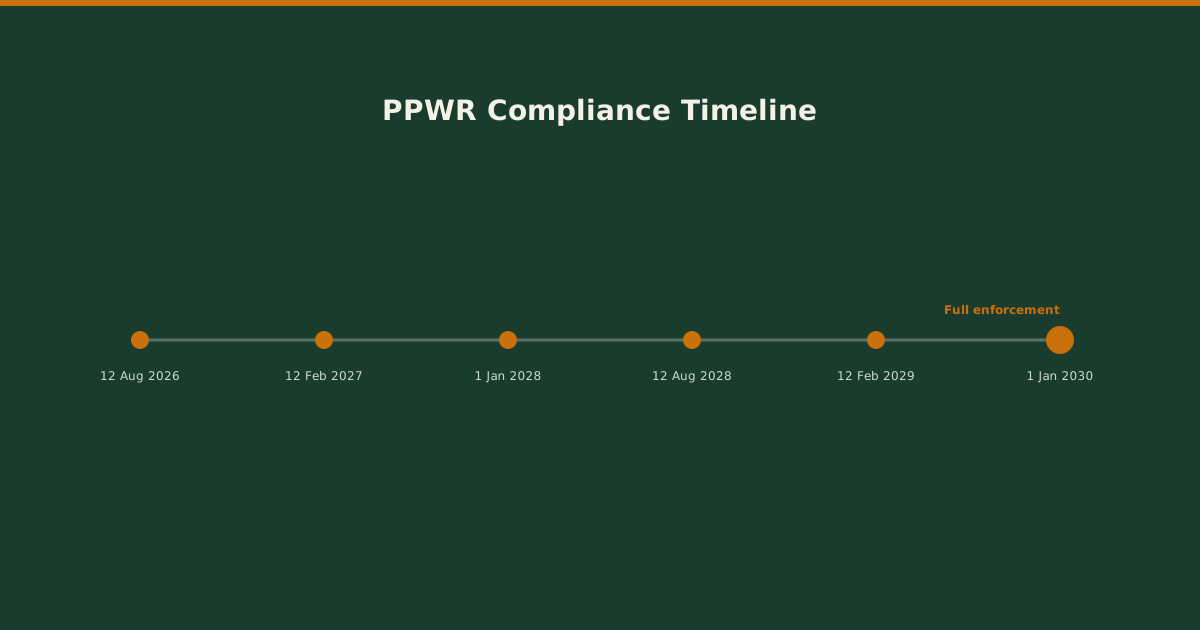
PPWR Deadlines: Complete Compliance Timeline 2026 to 2030
PPWR (Regulation (EU) 2025/40) enforcement phases across six milestones between 12 August 2026 and 1 January 2030, with long-tail targets stretching to 2035 and 2040. The 12 August 2026 deadline activates the regulation; the 1 January 2030 deadline is the hard enforcement cliff (grade D and E packaging restricted, 30% PCR binding for contact-sensitive PET, reuse targets binding). The four intervening dates structure the operational schedule. This guide walks every milestone with the stakeholder action required, the regulatory citation, and a downloadable ICS calendar export for board planning.
The timeline is the working schedule for every packaging producer placing goods on the EU market. The PPWR compliance pillar is the substantive reference; the 90-day readiness plan is the operational sprint to the first deadline.
In this guide:
- The six PPWR deadlines at a glance
- Each milestone walked: stakeholder action, regulation citation, what to ship
- Long-tail 2035 and 2040 targets
- What this means for your sprint plan
- 6-entry FAQ
- ICS calendar export instructions
PPWR Timeline at a Glance
PPWR enforcement runs across six milestones from 12 August 2026 through 1 January 2030: general application (2026), HORECA single-use restrictions (Feb 2027), recyclability and compostable criteria (Jan 2028), harmonised labelling (Aug 2028), digital product passport with QR codes (Feb 2029), and full enforcement including grade D/E restrictions and binding PCR thresholds (Jan 2030). Additional targets phase in through 2035 (reuse rates) and 2040 (50% PCR for contact-sensitive PET, 65% recyclability across categories).
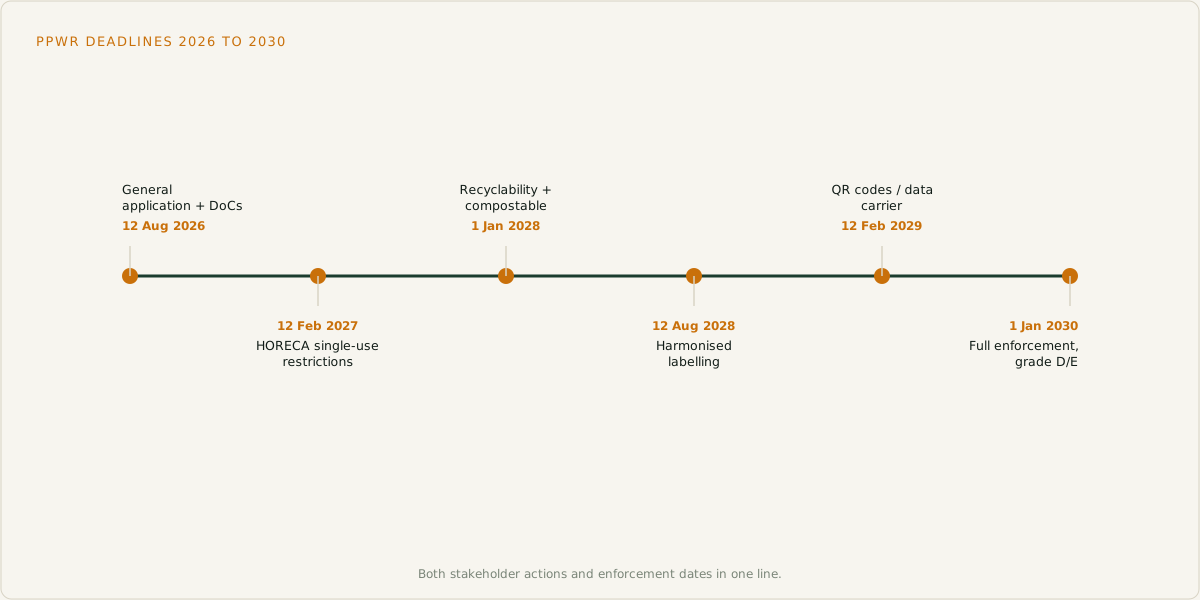
| Date | Milestone | Stakeholder action | Regulation reference |
|---|---|---|---|
| **12 August 2026** | General application; DoCs mandatory; Annex II grading required | Issue Annex VIII DoCs for every packaging type placed on the market | Article 11 + Annex VIII |
| **12 February 2027** | HORECA single-use packaging restrictions; cup and container reuse targets begin reporting | Align HORECA channel with reuse formats; report reuse share | Article 25 + 26 |
| **1 January 2028** | Recyclability criteria sharpen; compostable packaging requirements apply | Material substitution for grade D and E packaging; compostable EN 13432 evidence | Articles 6, 9, 25 |
| **12 August 2028** | Harmonised labelling specifications apply | Update artwork (material code, sorting pictogram) across SKU portfolio | Article 15 |
| **12 February 2029** | Digital Product Passport: QR-code disclosure on packaging | Generate QR codes per packaging type linking to composition, methodology, DoC reference | Article 16 |
| **1 January 2030** | Full enforcement: grade D/E restrictions, PCR thresholds binding, reuse targets binding, packaging minimisation rules | Restrict grade D and E placements; meet 30% PCR for contact-sensitive PET; document reuse share | Articles 6 + 7 + 9 + 10 + 24 |
12 August 2026: The Entry Point
The regulation activates. From this date, no packaging type may be placed on the EU market without a valid Annex VIII Declaration of Conformity. The substantive obligations under Articles 5 (PFAS), 6 (recyclability grading), 7 (recycled content baseline), and 11 (DoC) become enforceable. Member State authorities can request DoCs and must receive them within 10 working days under Article 11(5).
Stakeholder action by 12 August 2026:
- Every packaging type has a signed Annex VIII DoC (template guide)
- PFAS test certificates on file for every food-contact type (Article 5 guide)
- Annex II recyclability grade assigned per type using worst-of methodology (worst-of guide)
- PCR content traceability evidence (chain-of-custody certificates) on file
- Authorised signatory designated and delegation register documented
- 5-year (single-use) / 10-year (reusable) retention infrastructure operational
Failure to meet 12 August 2026 triggers escalation under Article 67 penalties. Existing inventory placed on the market before this date can continue moving through the channel.
12 February 2027: HORECA Restrictions
The HORECA channel (hotels, restaurants, cafés, institutional catering) receives specific single-use packaging restrictions. Single-use plastic cups, food containers, and condiment sachets are restricted in dine-in formats. Reuse targets for cups and containers in this channel begin reporting.
Stakeholder action by 12 February 2027:
- HORECA suppliers identify the affected formats in their portfolio
- Reusable container systems specified and contracted with HORECA operators
- Reuse-share reporting infrastructure operational for the affected categories
- Distributor agreements updated for the format substitutions
The impact is concentrated on HORECA-channel producers. Retail-channel and B2B-industrial packaging are largely unaffected at this date.
1 January 2028: Recyclability and Compostable Criteria
The recyclability framework sharpens: grade thresholds tighten, the 5% carve-out for non-recyclable components becomes more rigorously documented, and compostable packaging requirements apply for specific format categories (tea bags, coffee pods, fruit and vegetable bags for unpackaged produce, sticky labels on fresh fruit). EN 13432 certification becomes the evidence standard for compostable claims.
Stakeholder action by 1 January 2028:
- Identify grade D and E packaging types in the portfolio (workflow walked in Annex II worst-of guide)
- Begin redesign or material substitution work; full transition by 2030 cliff
- For compostable format categories: obtain EN 13432 certificates from suppliers
- Refresh DoC methodology codes (Field 7) where standard versions update
This is the first intermediate deadline that affects core packaging design rather than channel-specific formats. Producers using this date as a planning anchor typically begin design work by mid-2027.
12 August 2028: Harmonised Labelling
The EU-wide harmonised labelling specifications apply. Material codes, sorting pictograms, and consumer-facing recyclability indicators converge on a single Commission-approved system. National labelling schemes (France's Triman, Italy's environmental labelling, Germany's Grüner Punkt where applicable) continue to operate within the harmonised framework rather than being replaced wholesale.
Stakeholder action by 12 August 2028:
- Update artwork across the SKU portfolio with the harmonised material codes and pictograms
- Coordinate with brand and design teams on artwork lifecycle
- Update existing DoC Field 5 (Applicable Articles) to confirm Article 15 compliance
- Where French Triman compliance is in scope, integrate Triman within the harmonised framework
The labelling change is operationally heavy because it touches every SKU's artwork file. Most producers plan the artwork refresh for 18 to 24 months before the deadline, aligning with normal artwork-cycle updates.
12 February 2029: Digital Product Passport and QR Codes
Each packaging type carries a QR code linking to its digital product passport (DPP). The DPP discloses composition data, methodology codes, grade, PCR content, and the responsible party. The QR code is the consumer-facing interface to the DoC; the technical file sits behind the link.
Stakeholder action by 12 February 2029:
- Generate per-type QR codes via the Commission-designated registry interface
- Integrate QR codes into the harmonised labelling artwork (synchronise with the August 2028 artwork refresh)
- Maintain the digital product passport content (composition, methodology codes) current; DPP refreshes when the underlying DoC refreshes
- Plan for consumer-facing scanning analytics if relevant to your brand strategy
The DPP is a technical integration as much as a regulatory milestone. Producers begin DPP work in 2027 to 2028 ahead of the deadline.
1 January 2030: The Cliff Edge
Full enforcement. From this date:
- Grade D and E packaging may not be placed on the EU market, subject to limited exceptions documented in Annex II. The redesign pressure is hardest here: every D and E type still in circulation must transition or be withdrawn.
- 30% post-consumer recycled (PCR) content becomes binding for contact-sensitive PET packaging (food-contact bottles, trays). Other polymer families carry separate phased thresholds.
- Reuse targets become binding for several format categories (beverage transport, B2B grouped packaging, several retail formats).
- Article 24 packaging minimisation rules apply: every packaging type is assessed for empty-space ratio, redundant layers, and minimisation potential.
Stakeholder action by 1 January 2030:
- All grade D and E types redesigned, substituted, or formally exempted
- Supply contracts in place for the binding PCR thresholds (sourcing lead time is 18 to 24 months for tight supply categories)
- Reuse format infrastructure operational across affected channels
- Packaging minimisation assessment documented per type
The 2030 cliff is the date around which most multi-year sourcing decisions anchor. Producers locking in PCR supply contracts in 2025 to 2026 carry less specification risk through 2030.
2035 and 2040: Long-Tail Targets
Beyond 2030, the regulation phases additional targets:
- 2035: Reuse rate targets escalate (specific format-by-format figures in Article 26)
- 2040: 50% PCR for contact-sensitive PET (up from 30% at 2030); 65% recyclability across packaging categories
These dates are far enough out that they shape strategy rather than operations. Sourcing roadmaps, material substitution programmes, and reuse format investments calibrate against the 2035 and 2040 horizons rather than the 2030 cliff.
What This Means for Your Sprint Plan
The six deadlines map onto three planning horizons:
Near horizon (12 August 2026): 90 days from May 2026. The operational sprint plan is in the 90-day readiness plan guide. The minimum viable compliance ship: every type has a DoC, every grade is assigned, every PFAS certificate is on file. The portfolio is audit-ready, not yet optimised.
Medium horizon (2028 to 2029): Labelling refresh, QR codes / DPP integration. These are project-managed work streams rather than sprints. Plan 12-18 months ahead of each deadline.
Far horizon (2030 cliff + 2035/2040): Material substitution and reuse format investment. These are sourcing and capital decisions, not compliance projects. The 2030 grade D/E cliff is the most consequential single date for most producers.
The intervening dates (2027 HORECA, 2028 recyclability sharpening) affect specific channels or format categories rather than the whole portfolio. Identify whether your portfolio is in scope for these intermediate dates during the 90-day sprint.
ICS Calendar Export
A free ICS calendar file with all six PPWR milestones plus the 2035 and 2040 long-tail targets is available for download. Import into Outlook, Google Calendar, or Apple Calendar to put the dates on your board reporting cycle.
[Email field] [Download free PPWR.ics →]
Single-field signup, GDPR-compliant via Resend double opt-in, unsubscribe any time. The ICS arrives in your inbox along with monthly deadline reminders as each milestone approaches.
Frequently Asked Questions
Q1: What is the most important PPWR deadline? 12 August 2026 is the entry point: from that date, no packaging type may be placed on the EU market without a valid Annex VIII DoC. 1 January 2030 is the cliff: grade D and E packaging restricted, PCR thresholds binding, reuse targets binding. These two dates anchor most board-level PPWR planning. The four intervening dates structure the operational schedule.
Q2: What happens to existing packaging on the market on 12 August 2026? Inventory placed on the EU market before 12 August 2026 can continue moving through the channel after the deadline. Only new placements from 12 August 2026 onward require a valid DoC. This grace for existing inventory does not extend to grade D and E packaging after 1 January 2030; those types must be withdrawn.
Q3: Is the 1 January 2030 deadline negotiable? The 2030 cliff is fixed in the regulation text. Limited exceptions exist in Annex II for grade D and E types that meet specific criteria, but the default rule is restriction. Producers planning redesign cycles around the 2030 date should treat the deadline as binding and the exceptions as case-by-case rather than a general escape route.
Q4: How do PPWR deadlines interact with national scheme deadlines (VerpackG, Citeo, CONAI)? National scheme deadlines run separately. Germany's VerpackG, France's Citeo, Italy's CONAI, and Spain's Ecoembes administer their own registration, eco-modulation, and reporting deadlines that predate and continue alongside PPWR. The Germany VerpackG and PPWR guide walks the dual-compliance pathway for the German market.
Q5: When are the harmonised labelling rules actually enforced? Harmonised labelling applies from 12 August 2028. The Commission's implementing acts setting the specific pictograms and material codes are published 18 months ahead of application (so by February 2027). Producers refresh artwork on a 12-to-18-month cycle and typically synchronise with normal product launches rather than treating it as a standalone compliance project.
Q6: What is the PPWR digital product passport deadline? 12 February 2029. From that date, each packaging type carries a QR code linking to its digital product passport disclosing composition, methodology codes, grade, PCR content, and the responsible party. The DPP system is operationally heavy but technically straightforward where the underlying DoC infrastructure is already in place.
Conclusion
PPWR deadlines run from 12 August 2026 (entry point) through 1 January 2030 (cliff edge), with four intervening operational dates and long-tail targets reaching 2035 and 2040. The 12 August 2026 deadline is 90 days away for teams starting in May 2026; the 90-day readiness plan is the sprint structure that lands a 400-SKU portfolio audit-ready. The 1 January 2030 cliff anchors sourcing and material substitution decisions that need 18 to 24 months of lead time.
Carbonorm tracks every PPWR deadline against your portfolio: per-type readiness status, sourcing lead times for the 2030 PCR thresholds, artwork refresh cycles for 2028 labelling, DPP integration scaffolding for 2029. Start Audit; 50 SKUs free, no card required.
---
Read next:
- PPWR Compliance Pillar →
- What Is PPWR? Plain-English Overview →
- Who Does PPWR Apply To? Stakeholder Roles →
- PPWR Annex VIII DoC Template →
- 90-Day PPWR Readiness Plan →
- PPWR Article 67 Penalties →
- Germany VerpackG Overlay →
---