PPWR Article 11: Declaration of Conformity Mandate

PPWR Article 11: The Declaration of Conformity Mandate
Article 11 of Regulation (EU) 2025/40 establishes the Declaration of Conformity (DoC) as the central evidencing artefact of PPWR compliance. From 12 August 2026, no packaging type may be placed on the EU market unless its manufacturer (or importer-as-manufacturer under Article 21) has drawn up and signed a DoC following the model in Annex VIII of the regulation. This guide walks the Article 11 mandate, the mandatory contents of the DoC, the corrected 5-year / 10-year retention rule, the signing authority, what auditors look for, the six mistakes Member State enforcement teams cite most often, and the operational updates published in the Commission Guidance of 30 March 2026.
The DoC itself is short: a single-page artefact whose model template is set out in Annex VIII (the field-by-field walkthrough is in our Annex VIII DoC template guide). The legal weight is in Article 11. The two read together: Article 11 says you must, Annex VIII says how. A 400-SKU portfolio resolves into roughly 25 to 40 distinct packaging types, and each type carries its own DoC.
In this guide:
- The Article 11 mandate, in plain operational language
- What the DoC must contain (mapped to the Annex VIII model)
- How Article 21 shifts who issues the DoC
- The corrected 5-year and 10-year retention rule
- Who has authority to sign
- What Member State auditors look for first
- Six common mistakes that get teams fined
- Commission Guidance updates of 30 March 2026
- 10-entry FAQ
What Article 11 Requires
PPWR Article 11 obliges the manufacturer of every packaging type placed on the EU market to draw up a written Declaration of Conformity, following the Annex VIII model, attesting that the packaging meets the sustainability requirements of Articles 5 through 12 of Regulation (EU) 2025/40.
The Mandate, in Plain Terms
Article 11(1) imposes the obligation: the DoC is mandatory, drawn up before the packaging is placed on the market, and signed by an authorised representative of the responsible party. There is no de minimis exemption by company size, packaging volume, or distribution channel. Article 11(2) cross-references the Annex VIII model template as the binding format. Article 11(4) sets the retention obligation. Article 11(5) sets the response window when an authority requests the DoC.
The mandate applies to "packaging types," not individual SKUs. The Commission Guidance of 30 March 2026 confirmed the operational definition: a packaging type is a grouping that shares composition, format, function, and the set of Articles applicable. A beverage producer with 15 PET bottle sizes (250 ml through 2 litre) sharing the same composition and same applicable Articles issues one DoC, not fifteen. A bottle wall thickness change, a sleeve material change, or a closure system change can split one type into two.
Scope: Every Actor, Every Packaging
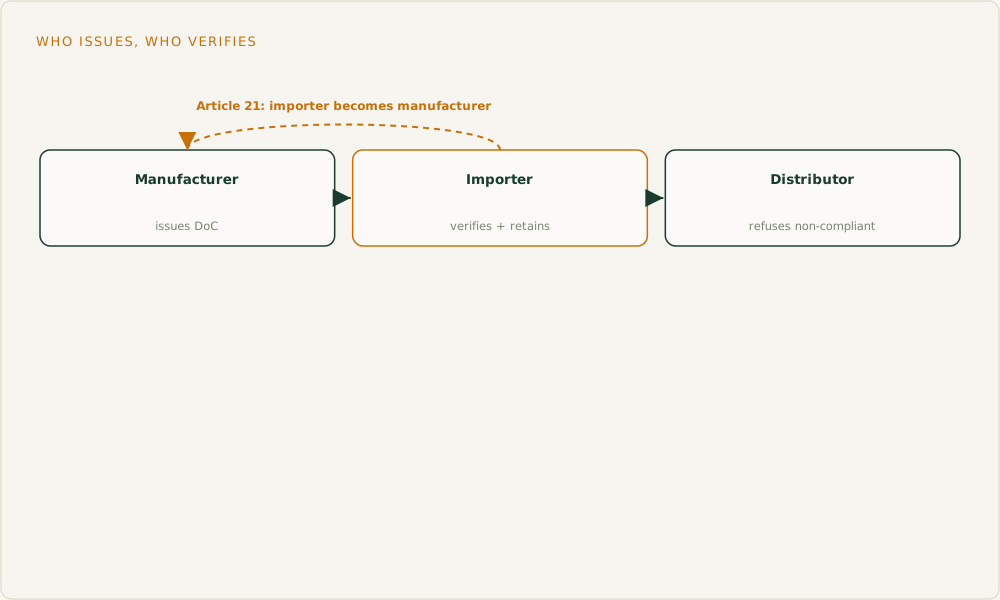
Article 11 applies to every actor placing packaging on the EU market, in any quantity, through any channel. Manufacturers issue the DoC; importers verify and retain it; distributors refuse to handle packaging unsupported by a valid DoC. The single test for scope is "is it placed on the EU market": if yes, Article 11 applies. The pillar guide walks the full deadline cascade for the regulation; the DoC mandate is the 2026 anchor obligation.
What the DoC Must Contain
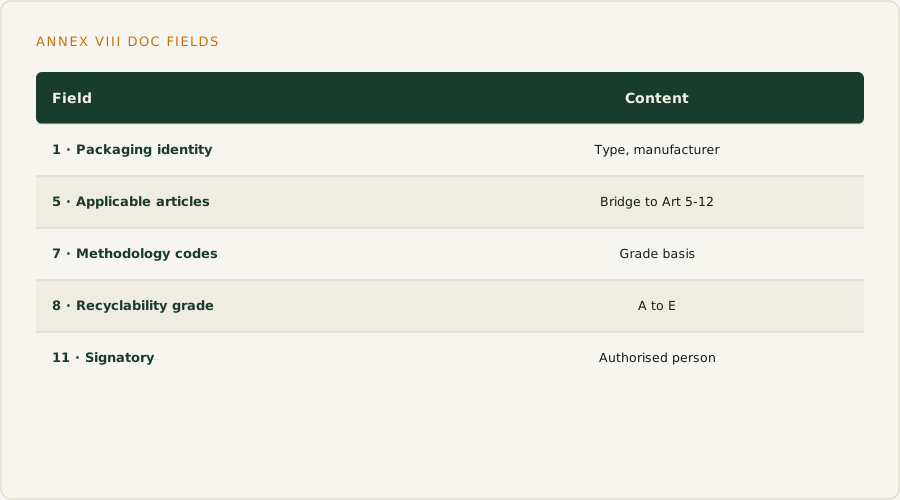
The DoC follows the Annex VIII model template prescribed by the regulation. The model is a single page with 12 mandatory fields; each field is enforceable. A DoC missing any required field is invalid and triggers the same audit consequence as no DoC at all.
The field-by-field walkthrough (with three worked SKU examples and a downloadable template) is in our Annex VIII DoC template guide. The summary structure:
| Field | Content | Why it matters |
|---|---|---|
| 1 | Manufacturer identification (legal name, address, EU representative if non-EU) | Identifies the responsible party |
| 2 | Importer identification (when Article 21 applies) | Routes obligation to EU-side party for private label |
| 3 | Packaging type identification (technical name, function, dimensions, weight range) | Defines the unit of declaration |
| 4 | Composition declaration (materials by mass percentage, supplier traceability) | Auditable composition baseline |
| 5 | Applicable Articles (5, 6, 7, 9, 10, 11, 12) | Sets the scope of the conformity claim |
| 6 | Sustainability compliance statement (standard declarative sentence) | The legal heart of the document |
| 7 | Methodology codes (test methods, certifications referenced) | The most-audited field |
| 8 | Recyclability grade (Annex II categorical grade A through E) | Per-type grading record |
| 9 | Post-consumer recycled (PCR) content percentage | Article 7 evidence |
| 10 | Date of issue | Audit-trail anchor |
| 11 | Validity period (event-driven, not time-driven) | Triggers re-issue on material change |
| 12 | Authorised signatory (name, title, signature) | Legal accountability |
The Conformity Statement, in Detail
Field 6 carries the legal heart of the document: a standard declarative sentence stating that the packaging type identified above conforms to the sustainability requirements set out in Articles 5 to 12 of Regulation (EU) 2025/40. This sentence is not negotiable; it is the operative attestation that triggers the manufacturer's responsibility under Article 11. The exact wording follows the Annex VIII model.
Methodology Codes: Field 7
Field 7 is where most DoCs fail audit. Each Article-specific claim requires a methodology code naming the test method or certification under which compliance was determined. Article 5 (PFAS) typically references EN 17681 for the extractable organofluorine test. Article 6 (recyclability) references RecyClass guidelines (e.g., RC-2024-A) or an equivalent recognised body. Article 7 (PCR content) references EuCertPlast chain-of-custody certification or equivalent. The Annex II worst-of methodology guide walks the grading rule behind Field 7 recyclability codes; the Annex VIII template page Field 7 section walks the code conventions per Article.
How Article 21 Changes the DoC Obligation
Article 21 is the trigger rule that decides who issues the DoC. The default reading of Article 11 is that the manufacturer (the party producing the packaging) is responsible. Article 21 reverses this when a party other than the original producer places the packaging on the EU market under their own name, trademark, or brand: that party becomes the manufacturer for PPWR purposes, and that party issues the DoC.
The Commission Guidance of 30 March 2026 broadened the reach of Article 21: private-label, white-label, and any visible EU brand placement triggers the rule, not only formal trademark registration. Three operational consequences follow.
First, the EU-side brand owner becomes responsible for collecting the composition, methodology, and grading evidence from the original supplier and drafting the Annex VIII DoC themselves. The contractual relationship continues, but the regulatory accountability sits with the EU-side party.
Second, the original non-EU supplier remains the source of the technical evidence but is not the regulatory issuer. Their supplier declarations feed Field 4 (composition) and Field 7 (methodology codes), but the signatory on Field 12 is the EU-side party.
Third, audit response (Article 11(5), 10 working day window) sits with the EU-side party. A regulator request lands in the brand owner's compliance file, not the supplier's. The Article 21 deep-dive walks the trigger conditions, three worked private-label scenarios, and the supplier-to-brand evidence handover.
Importer responsible under Article 21? See the [Article 21 deep-dive](/guides/ppwr-article-21-importer-manufacturer) for the 4 trigger scenarios and risk mitigation playbook.
Retention and Availability
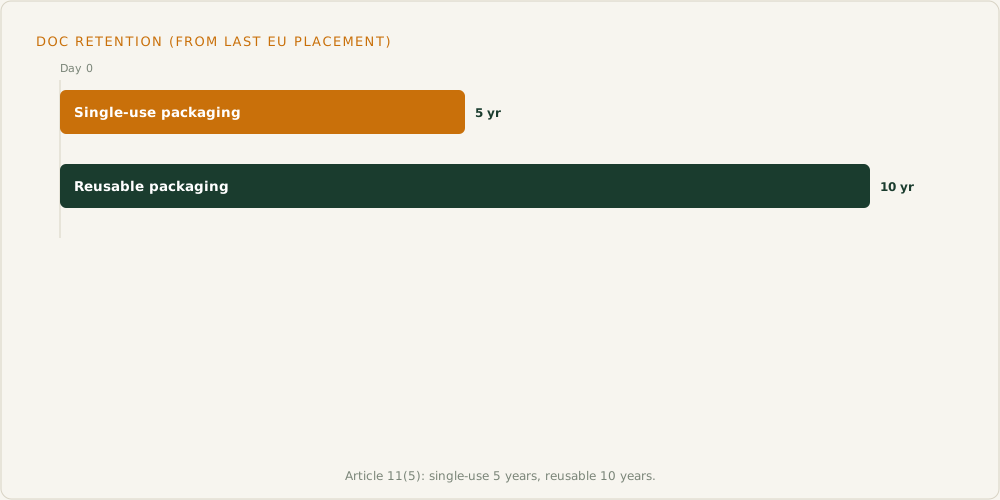
The retention clock anchors on the last placement date, not the date of issue. A DoC issued in February 2026 for a packaging type whose last placement is in March 2031 must be held until March 2036 (single-use) or March 2041 (reusable). Discontinuing the SKU shortens the holding obligation only relative to the discontinuation date, not the original issue date.
The retention obligation covers the DoC plus the supporting technical file: the documents and records evidencing the conformity claim. Article 12 distinguishes the technical file from the DoC itself; the technical file may include supplier certificates (PFAS test sheets, EuCertPlast chain-of-custody), laboratory reports, RecyClass assessment outputs, and version-controlled material specifications. Authorities can request both the DoC and the technical file; both must be producible.
Audit-Response Window
Article 11(5) requires that DoCs be produced within 10 working days of a request from a competent authority. Acceptable formats include PDF, machine-readable XML, or the original Annex VIII model in either electronic or printed form. The 10-day window is firm; non-response triggers escalation to Article 67 sanctions. Producers operating multi-location compliance archives ensure the response can be assembled within 10 working days even from a holiday period: the answer is a workflow design problem, not a goodwill problem.
Who Can Sign
The signatory in Field 12 of the DoC must be a person with authority to bind the responsible party. Three role-types satisfy the requirement.
Authorised representative of the manufacturer. A named officer (managing director, head of compliance, head of quality) whose authority to sign is documented in the company's signing-authority schedule. The Annex VIII signature can carry the role title alongside the name.
Authorised representative of the importer-as-manufacturer. Under Article 21, the EU-side party's authorised representative signs. The signing-authority schedule is internal to that party; the original non-EU producer does not appear in Field 12 unless they are also the EU-side responsible party.
Authorised external representative (EU representative for non-EU manufacturers). Article 19 of the regulation requires non-EU manufacturers without an EU establishment to designate an EU representative. That representative's authorised signatory can sign the DoC on behalf of the non-EU manufacturer where the manufacturer remains the responsible party (i.e., Article 21 has not flipped responsibility to a brand owner).
The Commission Guidance of 30 March 2026 explicitly confirmed that electronic signatures are acceptable under Article 11. Qualified electronic signatures (eIDAS-compliant) carry the same legal weight as manuscript signatures. Manuscript signatures remain valid. The choice is workflow, not regulatory.
What Auditors Look For
Member State enforcement teams (ZSVR in Germany, ADEME in France, MITECO in Spain, CONAI in Italy) audit DoCs against a shared pattern. The six checks below appear in nearly every audit protocol observed since the regulation entered into force.
- Is there a DoC at all? The first question; missing DoCs trigger immediate Article 67 escalation, not corrective action.
- Does the DoC match the packaging type actually on the market? Auditors cross-reference physical samples against Field 3 (packaging type identification) and Field 4 (composition). Drift between specification and product is a finding.
- Are methodology codes present in Field 7? Blank or "TBD" entries are the single most common audit failure. The Annex VIII Field 7 walkthrough walks the per-Article code conventions.
- Does the recyclability grade in Field 8 follow Annex II? Auditors verify the worst-of methodology was applied. A multilayer pack graded A by component-averaging instead of worst-of is a finding.
- Is the PCR content traceable in Field 9? Chain-of-custody certification (EuCertPlast or equivalent) must be cited and producible from the technical file.
- Is the signing authority documented? Field 12 names a signatory; auditors verify that signatory has authority in the company's signing-authority schedule.
Failing any of the six is rarely a single-cell error. It typically reveals an upstream process gap (supplier data missing, methodology code policy not set, signing authority not delegated). Member States issue corrective-action notices for first findings; repeat findings escalate to fines under Article 67.
Six DoC Mistakes That Get Teams Fined
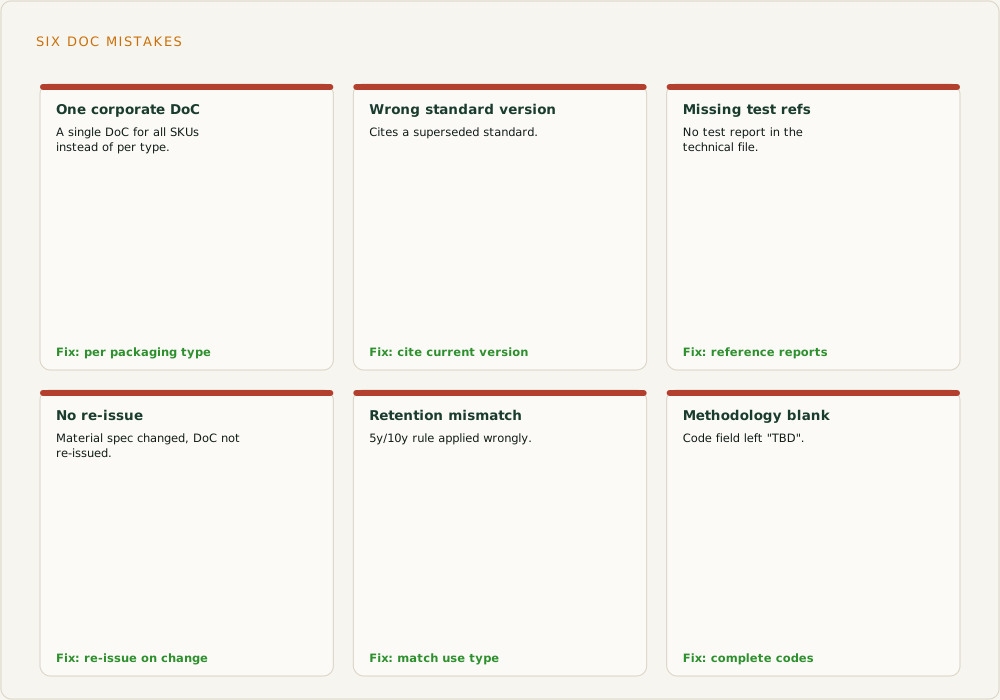
Mistake 1: One Corporate-Wide DoC Covering Everything
A single DoC drafted at the corporate level, intended to cover every SKU. The DoC is per packaging type, not per legal entity. Fix: group SKUs into types (composition, format, function, applicable Articles) and issue one DoC per type. A 400-SKU portfolio typically yields 25 to 40 DoCs.
Mistake 2: Wrong Standard Version Cited in Field 7
The methodology code references an older or superseded test method version. EN 17681 has version revisions; RecyClass guidelines update annually. Fix: maintain a methodology-code register that tracks active versions per Article, and re-issue DoCs when a referenced standard is superseded.
Mistake 3: Missing Test Report References in the Technical File
The DoC names a methodology code (e.g., "EN 17681-2024") but the technical file does not contain the supplier or laboratory test report evidencing the result. The DoC is producible; the supporting evidence is not. Fix: link each Field 7 entry to a versioned document in the technical file before the DoC is issued.
Mistake 4: No Re-Issue After Specification Change
The DoC is treated as a one-time artefact. When a supplier substitutes a material, the packaging type's composition has changed, and the prior DoC is no longer accurate. Fix: set re-issue triggers on every specification change, supplier substitution, or methodology update.
Mistake 5: Retention Rule Applied as a Flat 10 Years
Many internal compliance schedules adopted a flat 10-year retention from earlier guidance. The correct rule is 5 years for single-use packaging and 10 years for reusable packaging, from last placement. Fix: tag each packaging type as single-use or reusable in the compliance archive and apply retention accordingly.
Mistake 6: Methodology Code Field 7 Blank or "TBD"
The single most-cited audit failure in Member State reports. Field 7 left blank, marked "TBD," or filled with a generic phrase like "in accordance with regulation" fails the field's purpose. Fix: source the methodology code from the supplier or testing body before drafting; a DoC drafted without Field 7 evidence is not issuable.
Commission Guidance 30 March 2026: What Changed
The Commission's first round of operational guidance, published on 30 March 2026 (press release IP/26/664), addressed Article 11 directly on four points.
Packaging type definition. The Commission set the operational test (composition + format + function + applicable Articles) and confirmed that a 400-SKU portfolio resolves into roughly 25 to 40 distinct types, not 400 DoCs.
Electronic signature acceptance. Article 11 does not require manuscript signatures. eIDAS-compliant electronic signatures carry full legal weight on the DoC. End-to-end digital DoC workflows are explicitly supported.
Article 21 reach. The importer-as-manufacturer trigger applies to any visible EU brand placement, not only registered trademarks. Private-label and white-label arrangements are squarely in scope.
FAQ companion document. The Commission's FAQ document is hosted on the DG Environment website and is updated periodically. Subsequent rounds of guidance are expected ahead of 12 August 2026 and following the first wave of Member State enforcement actions.
Frequently Asked Questions
Q1: Who issues the DoC under Article 11? The manufacturer of the packaging issues the DoC by default. Under Article 21, an importer or other party placing the packaging on the EU market under their own brand becomes the manufacturer for PPWR purposes and issues the DoC themselves. The signatory is an authorised representative of the issuing party.
Q2: Can the DoC be signed electronically? Yes. The Commission Guidance of 30 March 2026 confirmed that electronic signatures, including eIDAS-compliant qualified electronic signatures, are acceptable on the Annex VIII DoC. Manuscript signatures remain valid. The choice is operational.
Q3: Do I need a separate DoC for each Member State? No. The DoC is EU-wide. A single Annex VIII DoC covers the packaging type across all 27 Member States. Local schemes (VerpackG / LUCID in Germany, Citeo in France, CONAI in Italy, Ecoembes in Spain) require their own registrations, but the DoC itself is unified.
Q4: How long must I keep the DoC? Five years for single-use packaging, ten years for reusable packaging, counted from the date the packaging was last placed on the EU market. The clock anchors on last placement, not on issue date. The technical file supporting the DoC must be retained for the same period.
Q5: Can a DoC be appealed or contested? The DoC is a self-declaration by the responsible party; it is not subject to appeal as such. A Member State authority finding a DoC deficient issues a corrective-action notice (or, for serious or repeated failures, an Article 67 sanction). The responsible party can contest the authority's finding through national administrative law procedures.
Q6: What happens if the DoC is missing during audit? Missing DoCs trigger immediate Article 67 escalation rather than corrective action. Member States may issue fines, order market withdrawal of the affected packaging type, and require remediation before re-placement on the market. The exposure is operational (withdrawal) as much as financial.
Q7: Does VerpackG / LUCID registration replace the DoC? No. VerpackG and the LUCID registration are separate German national obligations covering EPR financing and registration. The DoC is a PPWR obligation covering substantive sustainability requirements. Both are required for the German market. Our Germany VerpackG guide walks the LUCID registration alongside the DoC obligation.
Q8: How does Article 21 affect DoC issuance? Article 21 shifts the manufacturer role to the EU-side party when packaging is placed on the EU market under that party's name or brand. The EU-side party drafts and signs the DoC, holds the technical file, and answers regulator requests. The original non-EU producer remains the technical source but not the regulatory issuer. See the Article 21 guide for trigger scenarios.
Q9: Can Carbonorm generate Annex VIII DoCs automatically? Yes. The platform groups SKUs into packaging types, applies Annex II grading using the worst-of methodology, fills 11 of the 12 Annex VIII fields from your portfolio data (Field 12 requires signature), and maintains the technical file required by Article 11(4). The SKU and document workflow is the entry point.
Q10: Where can I find the Annex VIII model template? The model is set out in Annex VIII of Regulation (EU) 2025/40. Our Annex VIII DoC template guide walks the 12 fields with three worked examples (PET bottle, multilayer film, kraft mailer) and includes a free downloadable template pack (PDF + Word + Google Docs, EN + DE + TR).
Get Audit-Ready Before 12 August 2026
The Article 11 mandate is short to state and consequential to operate. The DoC is single-page but every field is enforceable; the retention rule is 5 or 10 years from last placement, not issue; Article 21 reroutes the manufacturer role for private-label arrangements; methodology codes in Field 7 are the most-audited field across Member State enforcement programmes. The 12 August 2026 deadline is the start of enforcement, not the end of preparation.
Carbonorm runs the DoC workflow end-to-end: SKU grouping into packaging types, Annex II grading under the worst-of methodology, Field 7 methodology code management, signature routing for Field 12, and the audit trail Article 11(4) requires for the 5-year or 10-year retention obligation. Start Audit; 50 SKUs free, no credit card required.
---
Read next:
- PPWR Annex VIII DoC Template →
- PPWR Article 21 Importer-as-Manufacturer →
- PPWR Annex II Worst-Of Methodology →
- PPWR Article 67 Penalties →
- PPWR Compliance Pillar →
- Germany VerpackG Overlay →
---